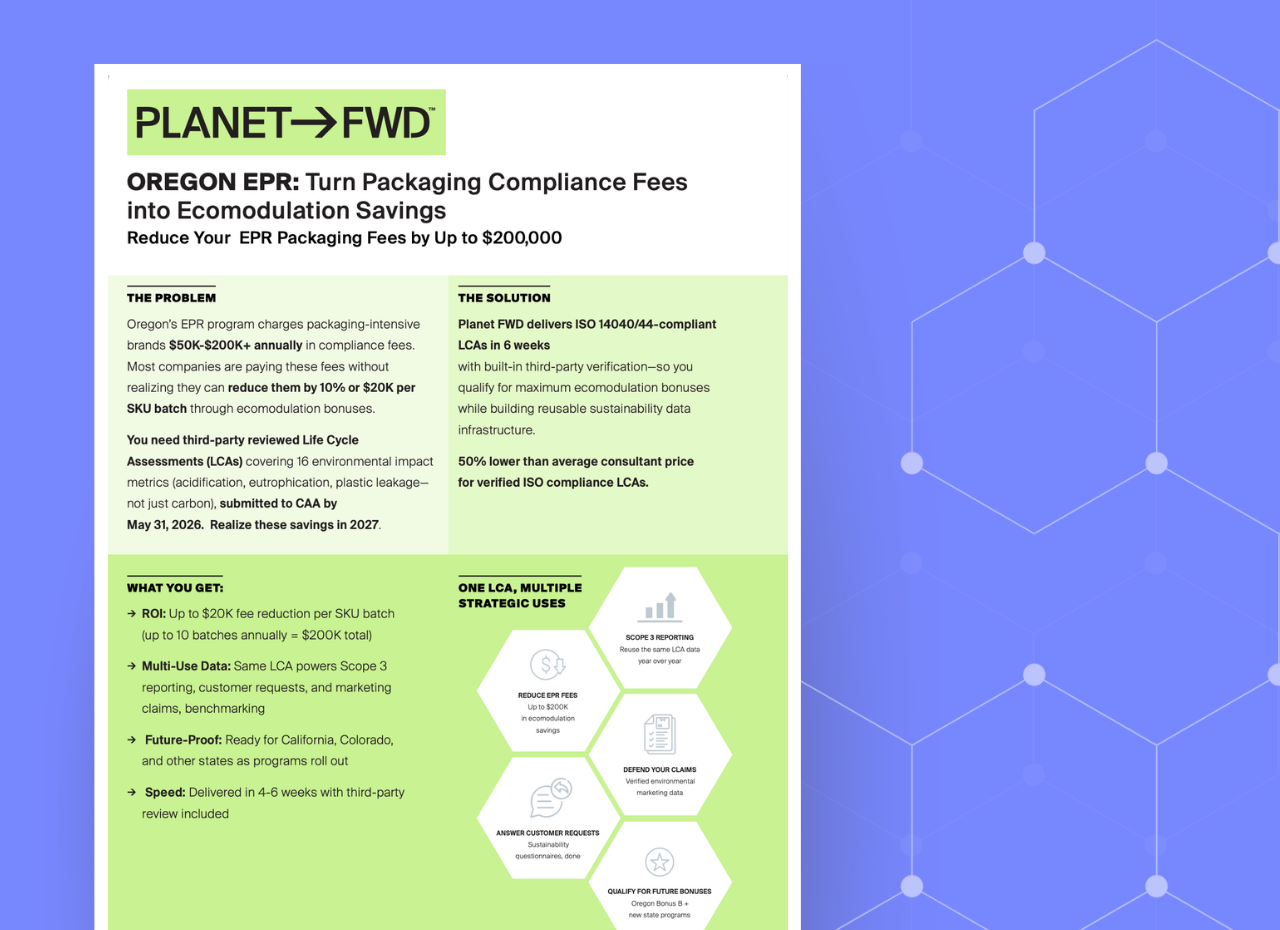
Oregon's EPR program charges packaging-intensive brands $50K–$200K+ annually in compliance fees. Most companies pay these fees without realizing they can reduce them through ecomodulation bonuses.
The mechanism is straightforward. Brands that submit third-party reviewed Life Cycle Assessments covering 16 environmental impact categories to Oregon's Circular Action Alliance (CAA) can qualify for a 10% fee reduction per SKU batch — up to $20,000 per batch and $200,000 annually.
The deadline to submit qualifying LCAs is May 31, 2026. The LCA process takes 6–8 weeks. That puts the practical start-by date in late March.
What this guide covers
Eligibility and qualification. Who qualifies for Bonus A (LCA disclosure) and Bonus B (demonstrated packaging improvements). The revenue thresholds, packaging categories, and producer types included under Oregon's program.
The ROI math. Three scenarios showing net savings at 3, 5, and 10 SKU batches — including the $16,000 per-batch investment and the corresponding fee reductions. Every scenario shows positive ROI by year two.
How ecomodulation bonuses work. A breakdown of how Oregon calculates fee adjustments based on material type, tonnage, and the 16 PEFCR EF 3.1 impact indicators. Includes worked examples for Bonus A and Bonus B across different packaging profiles.
Beyond Oregon. The same LCA data supports Scope 3 reporting, substantiated marketing claims, customer sustainability questionnaires, and readiness for California, Colorado, and other states rolling out EPR programs.
Timeline to meet the May 31 deadline. A week-by-week breakdown from packaging audit through third-party review and submission prep.
Who this is for
This guide is built for sustainability, regulatory, and packaging leaders at CPG brands selling packaged goods in Oregon. If your company pays EPR fees and you haven't explored ecomodulation, this is the starting point.
Common packaging profiles that benefit: food and beverage, beauty and personal care, apparel, household goods, and any brand with standardized packaging across product lines.
Lorem ipsum dolor sit amet, consectetur adipiscing elit. Consectetur, adipiscing elit, sed do eiusmod tempor incididunt ut lab. Lorem ipsum dolor sit amet, consectetur adipiscing elit. Lorem ipsum dolor sit amet, consectetur adipiscing elit.
What’s a Rich Text element?
The rich text element allows you to create and format headings, paragraphs, blockquotes, images, and video all in one place instead of having to add and format them individually. Just double-click and easily create content.
- This is a bullet item
- This is another item
- this is athird
Static and dynamic content editing
A rich text element can be used with static or dynamic content. For static content, just drop it into any page and begin editing. For dynamic content, add a rich text field to any collection and then connect a rich text element to that field in the settings panel. Voila!
How to customize formatting for each rich text
Headings, paragraphs, blockquotes, figures, images, and figure captions can all be styled after a class is added to the rich text element using the "When inside of" nested selector system.