Oregon's eco-modulation bonus program is fully approved. Here's what Bonus A, B, and C each require.
Oregon's EPR program has included eco-modulation bonuses since launch, but until recently, only Bonus A had formal producer guidance. On March 11, 2026, Circular Action Alliance released the official documentation for Bonus B and Bonus C. All three bonuses are now approved, fully documented, and open for submission ahead of the May 31, 2026 deadline. This article walks through what each bonus covers, who it's designed for, and how the economics work in practice.
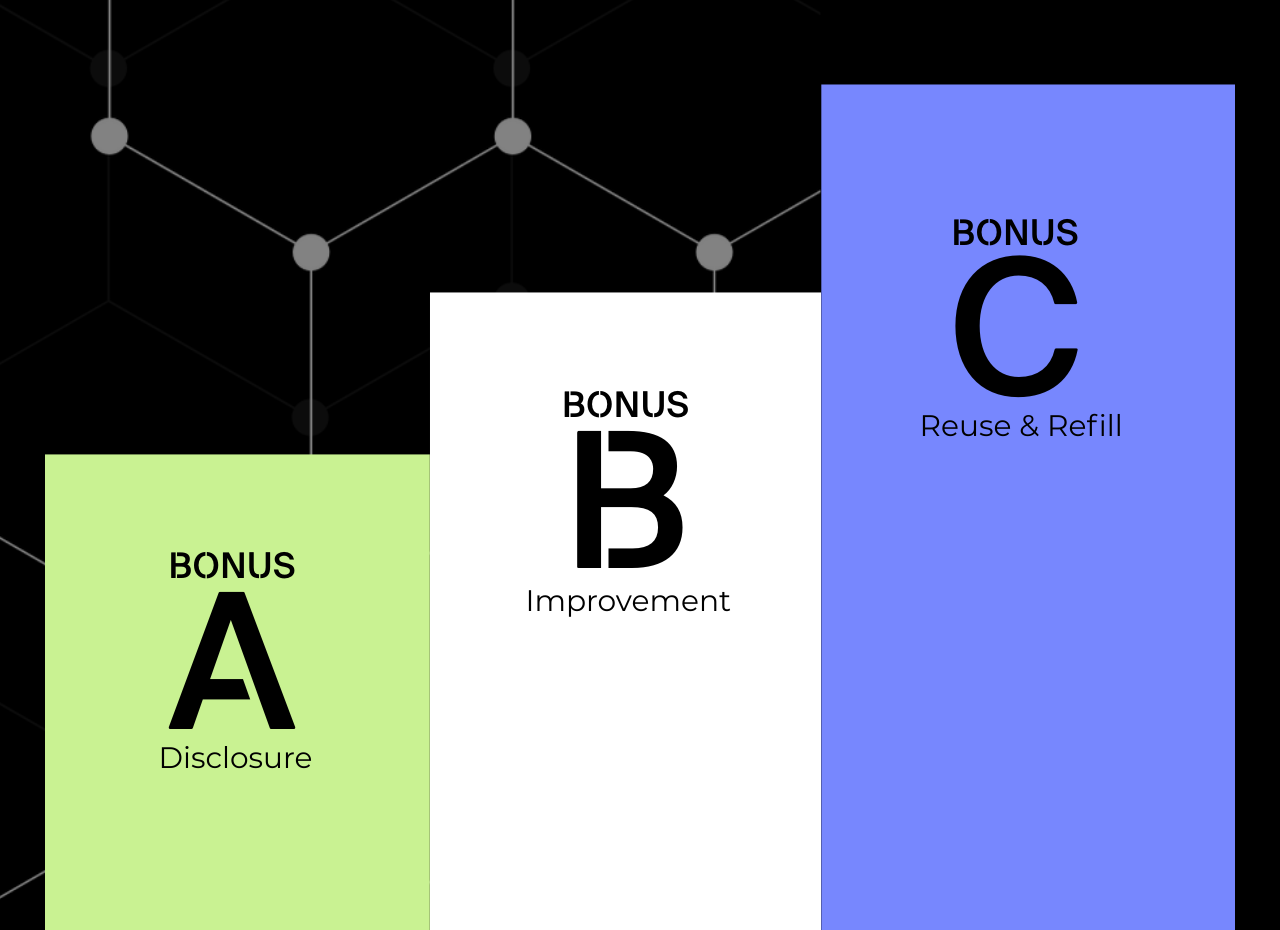
How the bonus program is structured
All three bonuses are applied as credits to your 2027 Oregon EPR invoice. Producers submit qualifying LCA reports to CAA by May 31, 2026. CAA reviews submissions and reflects approved bonuses in 2027 fee invoices.
The bonus is calculated as a percentage of your base EPR fees for the specific SKU or SKU batch covered by the LCA, not your total fee obligation. For any given SKU or SKU batch, you're eligible for one bonus per year: A, B, or C. You can submit up to 10 LCA reports annually across whichever bonus type you pursue, regardless of how many SKUs are included in each batch.
One thing worth understanding before diving into each bonus: Oregon's base EPR fees are tied to the weight and material type of packaging you put into the market. This matters particularly for Bonus B, which we'll explain below.
Bonus A: Voluntary LCA Disclosure
Bonus A rewards producers for conducting and disclosing a qualifying LCA on their covered product packaging. There's no minimum impact reduction threshold — the requirement is the rigor of the LCA itself, not a specific environmental outcome.
The bonus is worth up to 10% of base fees for the evaluated SKU or SKU batch, capped at $20,000 per LCA report. With up to 10 reports per year, the maximum annual benefit is $200,000.
Bonus A is well-suited for brands that haven't made recent packaging changes, are establishing their first LCA baseline, or are building toward Bonus B eligibility in future program years. The LCA data generated for a Bonus A submission becomes the baseline against which future improvements are measured — so there's long-term value in starting the work even if a Bonus B claim isn't possible yet.
The LCA requirements are the same across all three bonuses: 16 environmental impact categories, ISO 14040/44 methodology, cradle-to-grave system boundary, and independent third-party critical review. This is substantive work, but the financial bar for Bonus A is lower because no improvement demonstration is required.
Bonus B: Packaging Impact Reduction
Bonus B is designed for producers that have made a meaningful improvement to their packaging and can demonstrate that improvement through a comparative LCA. The report covers both the original packaging design and the improved version, and the reduction must show up across Oregon's 16-category impact framework.
The bonus is graduated across three tiers based on the magnitude of impact reduction:
- Tier 1 (10–40% reduction): 20% of base fees, capped at $40,000 per LCA report
- Tier 2 (40–70% reduction): 25% of base fees, capped at $45,000 per LCA report
- Tier 3 (70%+ reduction): 30% of base fees, capped at $50,000 per LCA report
CAA has designed the Bonus B caps to always exceed Bonus A — the intent is to make packaging improvement meaningfully more valuable than disclosure alone.
A note on how the bonus calculation works
The Bonus B credit is calculated on the resulting SKU's fee base — the improved packaging — not the original. This is worth understanding before modeling the ROI, because the financial picture looks different depending on the type of improvement you've made.
For brands making improvements within the same packaging format — increasing post-consumer recycled content, improving recyclability, lightweighting a container without a full material switch — the fee base stays relatively stable between the original and improved versions. In these cases, the bonus amount lands close to its cap and represents a clear standalone incentive.
For brands making a significant material switch, moving from a heavy rigid container to a lightweight flexible format, for example, the EPR fee base drops substantially just from the switch itself. The packaging change carries its own financial benefit in the form of lower base fees. The Bonus B credit is still real, but it's additive to savings that are already reflected elsewhere, not the primary driver.
Understanding which category applies to your situation helps set realistic expectations before committing to the LCA scope and investment.
Eligibility requirements: the packaging change must have occurred on or after December 1, 2024, and no earlier than two years before submission. The product must have been on the Oregon market for at least one year before report submission. The LCA must have been completed after July 1, 2025 and no earlier than one year before submission. The deadline for 2026 submissions is May 31.
Bonus C: Reuse and Refill Systems
Bonus C is Oregon's incentive for producers switching from single-use packaging to reusable or refillable formats. The impact reduction tiers mirror Bonus B, but the bonus duration and per-SKU caps vary depending on the pathway.
There are three pathways:
Reusable packaging using projected return rates: For brands with newer reuse programs that don't yet have full return rate performance data, Oregon has built in a three-year grace period. Producers use projected return rates to model impact reduction and can earn Bonus C for three consecutive years, provided they continue reporting annually. Capped at $40,000 per SKU batch per year.
Reusable packaging using actual return rates: For brands with established return data that demonstrates impact reduction beyond the single-use break-even point. Capped at $50,000 per SKU batch per year, also over three years.
Refillable packaging using actual refill rates: For consumer-refillable products with real refill rate data. Capped at $50,000 per SKU batch, granted for one year per cycle, eligible to reapply every three years.
Across all three pathways, producers can submit up to 10 LCA reports per year. For brands using actual return rates on reusable packaging, that puts the potential total at $500,000 per year and $1.5 million across the three-year bonus period.
Eligibility for Bonus C differs slightly from Bonus B: packaging must have been on the Oregon market for at least six months before submission (not one year). The December 1, 2024 change date still applies. The May 31 submission deadline is the same.
Bonus C is best suited for brands that already have a functioning reuse or refill system in- market with credible performance data. The projected return rate pathway was specifically designed to include brands earlier in that journey.
What applies across all three bonuses
Every bonus requires the same rigorous LCA foundation: 16 environmental impact categories, ISO 14040/44 compliance, cradle-to-grave scope, and independent third-party critical review. Producers must submit two versions of each report — a confidential version and a public version. Public versions of approved reports will be posted on CAA's website. Certain elements are required to be publicly available by DEQ rule, including impact assessment results, normalized weighted scores, and hazardous substance disclosures.
Producers must also be in Good Standing with CAA, including being current on reporting and fee obligations, to be eligible for any bonus.
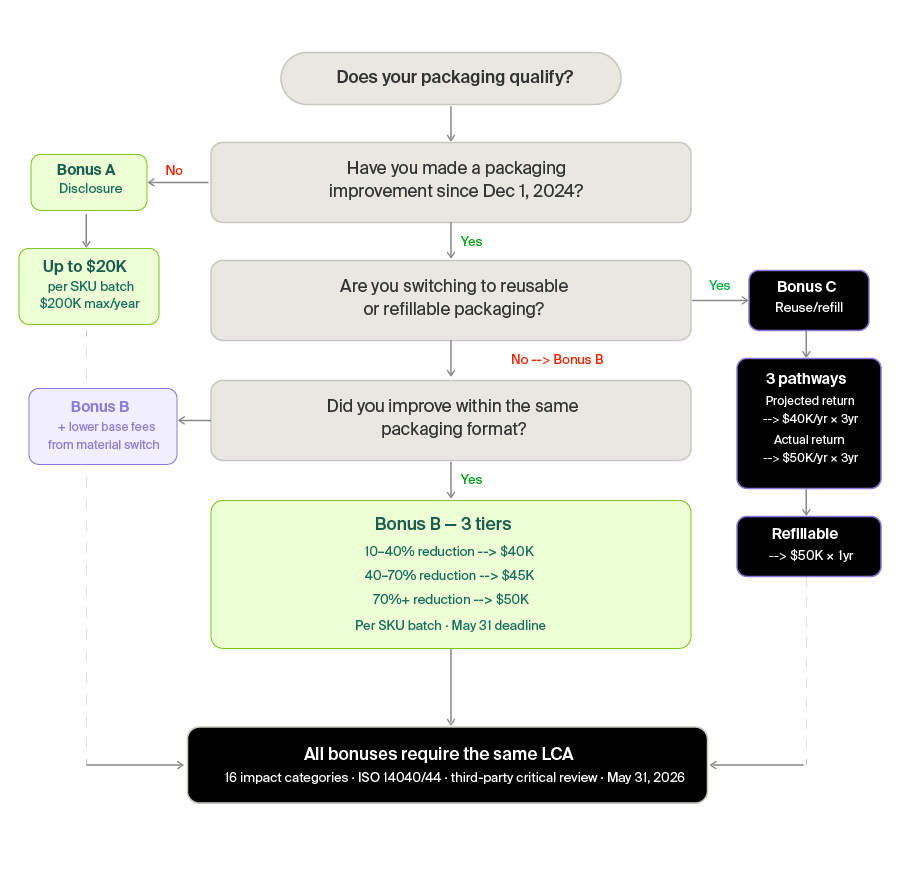
Thinking through which bonus applies
A few questions worth working through:
Have you made a packaging change since December 2024? If the change was within the same format (lightweighting, PCR content increase, recyclability improvement) Bonus B is worth evaluating and the economics are likely to be straightforward. If you made a full material switch, Bonus B may still apply, but model the fee base change alongside the bonus to get the full picture.
Do you have a reuse or refill system in-market with trackable performance data? Bonus C was designed for this, and the multi-year structure makes the economics compelling for brands with established programs.
Have you not made recent changes, or are you starting your LCA program from scratch? Bonus A establishes your baseline and keeps Bonus B and C options open in subsequent years.
One important planning consideration: you can submit for a bonus every year, but you cannot submit the same SKUs for the same bonus type in consecutive years. The three-year resubmission rule means it's worth thinking through your full product portfolio before committing to a sequencing strategy.
A brand with 20 SKUs has a lot of flexibility to rotate submissions across bonus types and product lines over time, and the right sequence depends on which SKUs have the most fee exposure, which have recent packaging changes, and which are candidates for future improvement.
Timing
Planet FWD delivers qualifying LCAs in six weeks. The submission deadline is May 31, 2026. Mid-April is the practical cutoff for starting the work.
Before engaging any LCA provider, two questions are worth asking: do they cover all 16 impact categories Oregon requires for its bonus program, and is their third-party reviewer experienced with this specific standard? These are more specific requirements than a standard carbon footprint or even a typical LCA, and most providers aren't set up for Oregon's program.
To learn more about how Planet FWD supports Oregon eco-modulation submissions, visit our Oregon EPR page →
Head of marketing
Lorem ipsum dolor sit amet, consectetur adipiscing elit. Consectetur, adipiscing elit, sed do eiusmod tempor incididunt ut lab. Lorem ipsum dolor sit amet, consectetur adipiscing elit. Lorem ipsum dolor sit amet, consectetur adipiscing elit.
This is an example blog post style
Lorem ipsum dolor sit amet, consectetur adipiscing elit, sed do eiusmod tempor incididunt ut labore et dolore magna aliqua. Sed vulputate odio ut enim. Volutpat sed cras ornare arcu dui. Lorem dolor sed viverra ipsum. Luctus accumsan tortor posuere ac ut consequat semper. Viverra justo nec ultrices dui sapien eget mi proin. Mollis nunc sed id semper risus in hendrerit gravida rutrum. Lacinia quis vel eros donec. Nisi vitae suscipit tellus mauris a diam. Ac orci phasellus egestas tellus rutrum tellus pellentesque eu tincidunt. Morbi quis commodo odio aenean sed adipiscing diam. Urna duis convallis convallis tellus id interdum. Tortor vitae purus faucibus ornare suspendisse sed. Vehicula ipsum a arcu cursus vitae congue. Enim sed faucibus turpis in. Orci eu lobortis elementum nibh tellus molestie nunc non blandit.
Nunc id cursus metus aliquam eleifend mi in. A erat nam at lectus urna duis convallis convallis. Tristique senectus et netus et malesuada fames ac. Id interdum velit laoreet id donec. Egestas dui id ornare arcu odio. Gravida rutrum quisque non tellus orci ac auctor. Malesuada fames ac turpis egestas maecenas pharetra convallis. Ut diam quam nulla porttitor. Eget nunc lobortis mattis aliquam faucibus purus. Aenean sed adipiscing diam donec adipiscing tristique risus nec. Nisi est sit amet facilisis magna etiam tempor orci eu. Tortor posuere ac ut consequat.
“Lorem ipsum dolor sit amet, consectetur adipiscing elit”
<span class="blockquote-wrap">
<strong>Naomi</strong>
Head of marketing
</span>

This is an example blog post style
Lorem ipsum dolor sit amet, consectetur adipiscing elit, sed do eiusmod tempor incididunt ut labore et dolore magna aliqua. Sed vulputate odio ut enim. Volutpat sed cras ornare arcu dui. Lorem dolor sed viverra ipsum. Luctus accumsan tortor posuere ac ut consequat semper. Viverra justo nec ultrices dui sapien eget mi proin. Mollis nunc sed id semper risus in hendrerit gravida rutrum. Lacinia quis vel eros donec. Nisi vitae suscipit tellus mauris a diam. Ac orci phasellus egestas tellus rutrum tellus pellentesque eu tincidunt. Morbi quis commodo odio aenean sed adipiscing diam. Urna duis convallis convallis tellus id interdum. Tortor vitae purus faucibus ornare suspendisse sed. Vehicula ipsum a arcu cursus vitae congue. Enim sed faucibus turpis in. Orci eu lobortis elementum nibh tellus molestie nunc non blandit.
<span class="rtb-protip">
<span class="rtb-protip-title"></span>
<span class="rtb-protip-body">Lorem ipsum dolor sit amet, consectetur adipiscing elit, sed do eiusmod tempor incididunt ut labore et dolore magna aliqua. Ut enim ad minim.</span></span>
How to customize formatting for each rich text
- Lorem ipsum dolor sit amet, consectetur adipiscing elit sed do eiusmod
- Lorem ipsum dolor sit amet, consectetur adipiscing elit sed do eiusmod
- Lorem ipsum dolor sit amet, consectetur adipiscing elit sed do eiusmod
- Lorem ipsum dolor sit amet, consectetur adipiscing elit sed do eiusmod
Headings, paragraphs, blockquotes, figures, images, and figure captions can all be styled after a class is added to the rich text element using the "When inside of" nested selector system.
Static and dynamic content editing
A rich text element can be used with static or dynamic content. For static content, just drop it into any page and begin editing. For dynamic content, add a rich text field to any collection and then connect a rich text element to that field in the settings panel. Voila!
- Lorem ipsum dolor sit amet, consectetur adipiscing elit sed do eiusmod
- For static content, just drop it into any page and begin editing. For static content, just drop it into any page and begin editing.
- Lorem ipsum dolor sit amet, consectetur adipiscing
How to customize formatting for each heading
Headings, paragraphs, blockquotes, figures, images, and figure captions can all be styled after a class is added to the rich text element using the "When inside of" nested selector system.