How we measure the environmental impact of upcycled and recycled food ingredients
The recycled content method is a well-established LCA approach — but most people don't realize it applies to food. Here's how Planet FWD uses it, why it's the right choice, and what it looks like in practice with upcycled food brands.
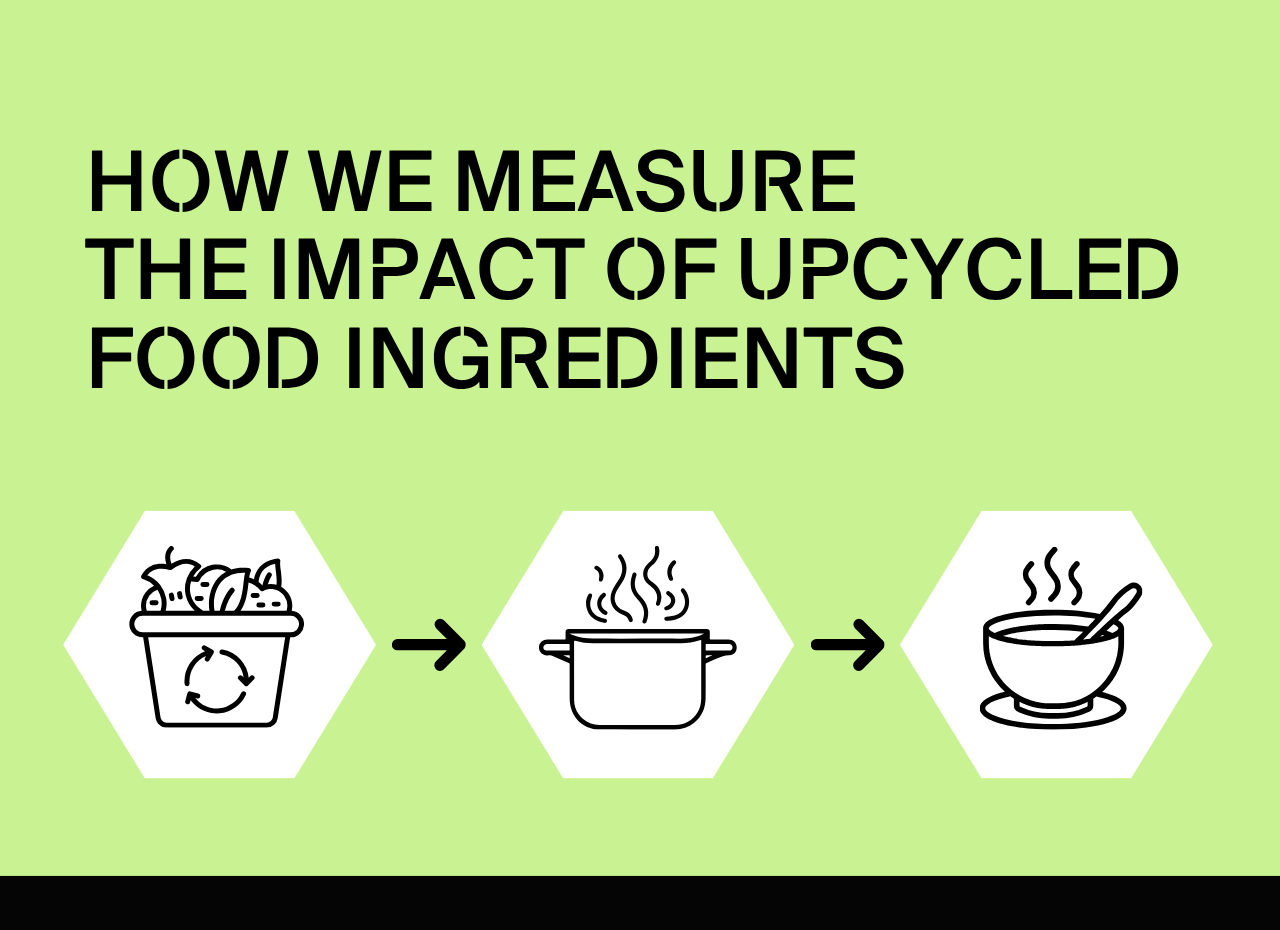
One of the most common questions we get when working with upcycled food brands is some version of this: how do you actually account for the fact that these ingredients would have gone to waste? How do you quantify that? And is the approach defensible?
These are fair questions. The environmental story of an upcycled product depends entirely on where you draw the system boundary and how you handle the allocation of environmental burdens across a material's multiple lives. Get it wrong and the numbers don't reflect reality. Get it right and you have data that can hold up to scrutiny from retailers, investors, and regulators.
This post explains the methodology we use, why we use it, and what it looks like when applied to real products and supply chains.
The core challenge: materials with multiple lives
Standard life cycle assessment methodology was built around linear systems — a product is made, used, and disposed of. Recycling and upcycling complicate that picture. When a material has more than one life, someone has to decide how to allocate the environmental burdens between the system that produced the original material and the system that uses it in a new form.
There are two broadly accepted approaches to this allocation question. The first is the end-of-life recycling method, also called the avoided burden approach, which gives the first product system a credit for the recycled material it sends forward — on the theory that it's displacing future virgin material production. The second is the recycled content method, also called the cut-off approach, which draws the system boundary at the point where material enters the waste or recycling stream. Under this approach, the original producer is responsible for the material up to that point, and the second system — the one that uses the recycled or upcycled input — takes on only the burdens of transport, processing, and use from that point forward.
Why we use the recycled content method
Planet FWD employs the recycled content method for LCAs in which any inflows are diverted from waste. This is one of the most widely used allocation approaches in the field, recognized in ISO 14040/44 standards, the GHG Protocol Product Standard, and common LCA databases including Ecoinvent. The World Resources Institute identifies it as a standard approach for emissions accounting. We use it because it's well-established, broadly accepted, and the right fit for the supply chains we work with.
The recycled content method works well for upcycled and recycled food ingredients for a few specific reasons. It avoids double-counting recycling benefits across product systems, which matters when multiple downstream users might be claiming credit for the same upstream material. It applies consistently across complex, geographically distributed supply chains. And it assigns the benefit to the system that actually uses the recovered material — directly rewarding the companies doing the work of diverting waste and building the infrastructure to use it.
For a brand using upcycled vegetables or food processing remnants, those inputs enter the LCA with zero upstream emissions burden. The environmental accounting starts at the point where those ingredients would otherwise have become waste. This accurately reflects what's happening in the supply chain — the upcycled system only comes into existence because another system generated material it couldn't use.
A note on what's novel here
The recycled content method is standard practice in materials-focused LCA work — packaging, textiles, metals. What's less common is applying it rigorously to food. Most food LCAs treat all agricultural inputs as if they were sourced fresh, because most food systems are designed that way. The upcycled food sector requires a different approach — one that can accurately represent ingredients that have already traveled partway through another product system before being redirected into food.
Building this capability required careful work: modeling primary processing of upcycled inputs, accounting for the specific machinery and energy use involved in transformation, and drawing system boundaries consistently and defensibly. The methodology itself is the same one used across the broader LCA field. The application to food ingredients requires attention to the specific characteristics of upcycled supply chains.
What this looks like in practice
The Spare Food Co. makes Spare Starter, a shelf-stable cooked vegetable blend comprising six surplus vegetables — onions, tomatoes, cauliflower, summer squash, peppers, and eggplant — purchased from farms where they would otherwise not have been sold. The Spare Food team needed a partner that could model primary processing of upcycled ingredients with the flexibility to capture the specific benefits of food saved from the landfill.
Using the recycled content method, Planet FWD conducted a cradle-to-gate LCA for Spare Starter, measuring the full impact of those upcycled ingredients and benchmarking against conventional alternatives. For a food service operator replacing 160 lbs of conventional vegetables per week with five pails of Spare Starter — equivalent to around 600 portions — the annual savings come to approximately 4.5 short tons of CO2e and 197,500 gallons of water.
As Jeremy Kaye, Co-founder and CEO of The Spare Food Co., put it: "Planet FWD's unique analytical methods and clear, actionable data was critical in helping us not only quantify the attributes of Spare Starter, but also the impact it has in large-scale food service operations."
Read the full Spare Food Co. case study →
_____________________________________________________________
Matriark Foods upcycles farm surplus and fresh-cut remnants into broths, sauces, and stews for schools, hospitals, food banks, and foodservice. Planet FWD modeled the step-by-step production process down to the specific machinery used in transforming those vegetables — which proved to be the lowest emissions processing step, a meaningful finding given that energy from production is typically a main driver of emissions in food LCAs.
The resulting data revealed the full emissions profile of each product line and enabled direct benchmarking against conventional alternatives. Matriark's Liquid Mirepoix has a 94% lower footprint by using upcycled vegetables. Their pasta sauces have a 37% lower footprint than sauces using conventional tomatoes and glass jars.
As Anna Hammond, Founder and CEO of Matriark Foods, noted: "Working with Planet FWD gave us the data we need to communicate to our customers that Matriark is a values-based, authentic, environmental impact food company."
Read the full Matriark Foods case study →
_____________________________________________________________
In both cases, the recycled content method is what made it possible to accurately represent the environmental benefit of the upcycled sourcing decision. A standard LCA treating those inputs as conventional agricultural products would have missed the story entirely.
On methodology transparency
We publish our methodology, including the use of the recycled content method, in our LCA methodology documentation. That transparency matters — both for the brands we work with and for the broader credibility of the upcycled food sector.
The upcycled food industry is growing. The companies driving that growth need emissions data that can stand behind their claims with retailers, respond to questions from sustainability teams, and hold up under third-party review. That calls for a methodology that is established, defensible, and consistently applied. The recycled content method has been used by LCA practitioners across industries for decades. Recognizing it in ISO standards and the GHG Protocol didn't make it credible — it was already credible, which is why those bodies recognized it.
We're glad to walk through how this methodology applies to a specific supply chain with any team that wants to understand it.
If you're building or scaling an upcycled food brand and want to understand how an LCA would work for your products, get in touch with our team →
Head of marketing
Lorem ipsum dolor sit amet, consectetur adipiscing elit. Consectetur, adipiscing elit, sed do eiusmod tempor incididunt ut lab. Lorem ipsum dolor sit amet, consectetur adipiscing elit. Lorem ipsum dolor sit amet, consectetur adipiscing elit.
This is an example blog post style
Lorem ipsum dolor sit amet, consectetur adipiscing elit, sed do eiusmod tempor incididunt ut labore et dolore magna aliqua. Sed vulputate odio ut enim. Volutpat sed cras ornare arcu dui. Lorem dolor sed viverra ipsum. Luctus accumsan tortor posuere ac ut consequat semper. Viverra justo nec ultrices dui sapien eget mi proin. Mollis nunc sed id semper risus in hendrerit gravida rutrum. Lacinia quis vel eros donec. Nisi vitae suscipit tellus mauris a diam. Ac orci phasellus egestas tellus rutrum tellus pellentesque eu tincidunt. Morbi quis commodo odio aenean sed adipiscing diam. Urna duis convallis convallis tellus id interdum. Tortor vitae purus faucibus ornare suspendisse sed. Vehicula ipsum a arcu cursus vitae congue. Enim sed faucibus turpis in. Orci eu lobortis elementum nibh tellus molestie nunc non blandit.
Nunc id cursus metus aliquam eleifend mi in. A erat nam at lectus urna duis convallis convallis. Tristique senectus et netus et malesuada fames ac. Id interdum velit laoreet id donec. Egestas dui id ornare arcu odio. Gravida rutrum quisque non tellus orci ac auctor. Malesuada fames ac turpis egestas maecenas pharetra convallis. Ut diam quam nulla porttitor. Eget nunc lobortis mattis aliquam faucibus purus. Aenean sed adipiscing diam donec adipiscing tristique risus nec. Nisi est sit amet facilisis magna etiam tempor orci eu. Tortor posuere ac ut consequat.
“Lorem ipsum dolor sit amet, consectetur adipiscing elit”
<span class="blockquote-wrap">
<strong>Naomi</strong>
Head of marketing
</span>

This is an example blog post style
Lorem ipsum dolor sit amet, consectetur adipiscing elit, sed do eiusmod tempor incididunt ut labore et dolore magna aliqua. Sed vulputate odio ut enim. Volutpat sed cras ornare arcu dui. Lorem dolor sed viverra ipsum. Luctus accumsan tortor posuere ac ut consequat semper. Viverra justo nec ultrices dui sapien eget mi proin. Mollis nunc sed id semper risus in hendrerit gravida rutrum. Lacinia quis vel eros donec. Nisi vitae suscipit tellus mauris a diam. Ac orci phasellus egestas tellus rutrum tellus pellentesque eu tincidunt. Morbi quis commodo odio aenean sed adipiscing diam. Urna duis convallis convallis tellus id interdum. Tortor vitae purus faucibus ornare suspendisse sed. Vehicula ipsum a arcu cursus vitae congue. Enim sed faucibus turpis in. Orci eu lobortis elementum nibh tellus molestie nunc non blandit.
<span class="rtb-protip">
<span class="rtb-protip-title"></span>
<span class="rtb-protip-body">Lorem ipsum dolor sit amet, consectetur adipiscing elit, sed do eiusmod tempor incididunt ut labore et dolore magna aliqua. Ut enim ad minim.</span></span>
How to customize formatting for each rich text
- Lorem ipsum dolor sit amet, consectetur adipiscing elit sed do eiusmod
- Lorem ipsum dolor sit amet, consectetur adipiscing elit sed do eiusmod
- Lorem ipsum dolor sit amet, consectetur adipiscing elit sed do eiusmod
- Lorem ipsum dolor sit amet, consectetur adipiscing elit sed do eiusmod
Headings, paragraphs, blockquotes, figures, images, and figure captions can all be styled after a class is added to the rich text element using the "When inside of" nested selector system.
Static and dynamic content editing
A rich text element can be used with static or dynamic content. For static content, just drop it into any page and begin editing. For dynamic content, add a rich text field to any collection and then connect a rich text element to that field in the settings panel. Voila!
- Lorem ipsum dolor sit amet, consectetur adipiscing elit sed do eiusmod
- For static content, just drop it into any page and begin editing. For static content, just drop it into any page and begin editing.
- Lorem ipsum dolor sit amet, consectetur adipiscing
How to customize formatting for each heading
Headings, paragraphs, blockquotes, figures, images, and figure captions can all be styled after a class is added to the rich text element using the "When inside of" nested selector system.