Land-Use Change: Which Commodities Carry the Most Risk, and How to Reduce Your Emissions
The GHG Protocol's Land Sector and Removals Standard sets new rules for how companies account for land emissions starting with 2026 data. That's the compliance driver. The deeper reason to pay attention is what sits underneath it: your land-use-change footprint depends on which commodities you buy and where they come from. This piece covers why land-use change matters, the commodities that carry the most risk, and what you can do to bring your emissions down.
Why should you care about land-use change beyond compliance?
Land-use change is one of the fundamental drivers of climate change, biodiversity loss, and long-term business risk. Three reasons it belongs on your radar:
It's a major emissions source. When forests, peatlands, or grasslands are converted to agriculture or other uses, the carbon stored in those ecosystems is released, and their future capacity to absorb carbon is lost. Emissions from agriculture and land-use change account for roughly a quarter of global greenhouse gas emissions.
It's the leading driver of biodiversity loss. Habitat conversion and fragmentation are responsible for much of the global decline in species and ecosystem health. Once an ecosystem is degraded, the services it provided, pollination, water regulation, soil fertility, pest control, become harder and more expensive to replace.
It's a direct supply-chain risk. Companies depend on healthy ecosystems for agricultural yields, water, and raw materials. Deforestation and land degradation can raise costs, disrupt supply, reduce yields, and create reputational and regulatory exposure. The land your supply chain depends on is also the land your numbers now have to account for.
Beyond voluntary accounting standards, hard trade regulations are turning deforestation-free supply chains into a baseline legal requirement to operate. Under the EU Deforestation Regulation (EUDR), large and medium-sized companies face a binding compliance deadline of December 30, 2026. If you cannot physically prove with geolocation data that commodities like beef, soy, palm, or cocoa were grown on land free from recent deforestation, your products face outright import bans and massive financial penalties. Measuring your land footprint isn't just a corporate social responsibility initiative anymore; it is active risk management to prevent your products from being locked out of the global marketplace..
What's the difference between direct and indirect land-use change?
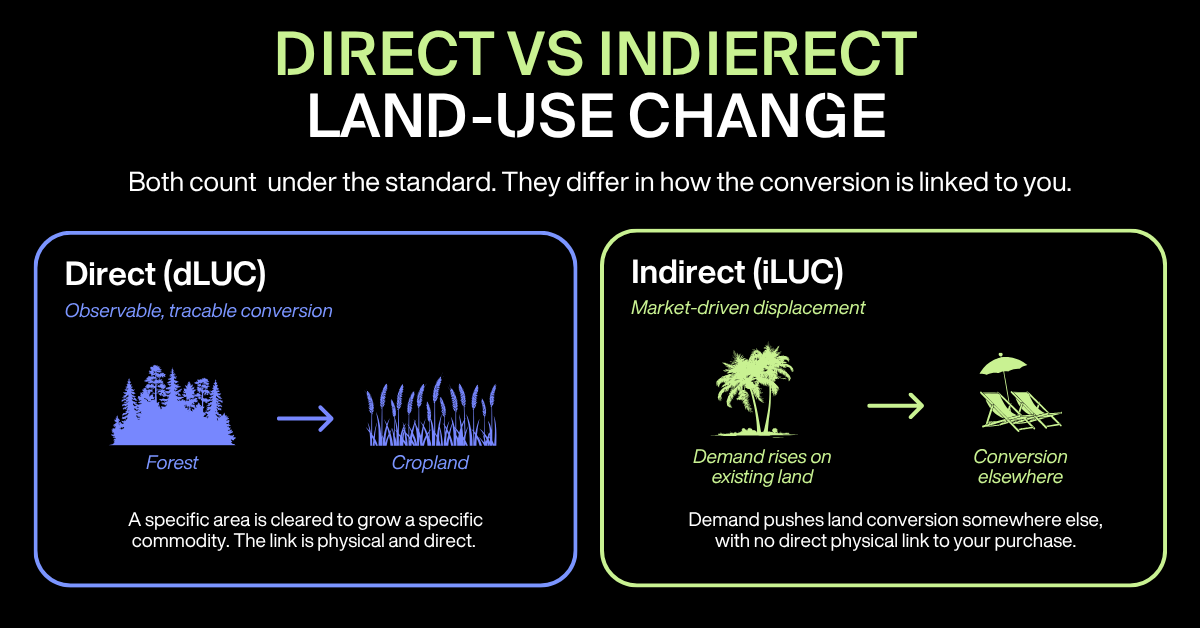
Direct land-use change (dLUC) happens when a specific piece of land is converted from one use to another and can be linked to a particular activity or commodity, clearing forest to plant a crop, for example. It's observable and traceable.
Indirect land-use change (iLUC) happens when demand for a commodity drives land conversion somewhere else, even with no direct physical link between your purchase and the converted land. Grow more fuel on existing cropland, and food production gets pushed onto new land elsewhere.
Indirect land-use change is an active and contested topic, much of it coming out of the biofuels debate over what happens when cropland grows fuel instead of food. Our view is that leaving indirect effects out understates the real impact, and statistical accounting methods are well suited to capturing them.
This is where statistical land-use change (sLUC) serves as a vital bridge. The Standard explicitly recognizes sLUC as a combination of both direct and indirect emissions that cannot be cleanly uncoupled due to a lack of farm-level traceability. When you rely on regional statistical datasets, you are looking at the net ecosystem conversion across an entire jurisdiction. Because sLUC models allocate a shared responsibility for that regional conversion footprint based on the total land area a commodity occupies, the resulting number inherently wraps both the direct physical clearing and the market-driven indirect displacement into a single, comprehensive risk metric.
Which commodities carry the most land-use-change risk?
If you buy large volumes of certain commodities, land-use change is likely a material part of your footprint. The risk concentrates in a few commodities tied to tropical deforestation and ecosystem conversion.

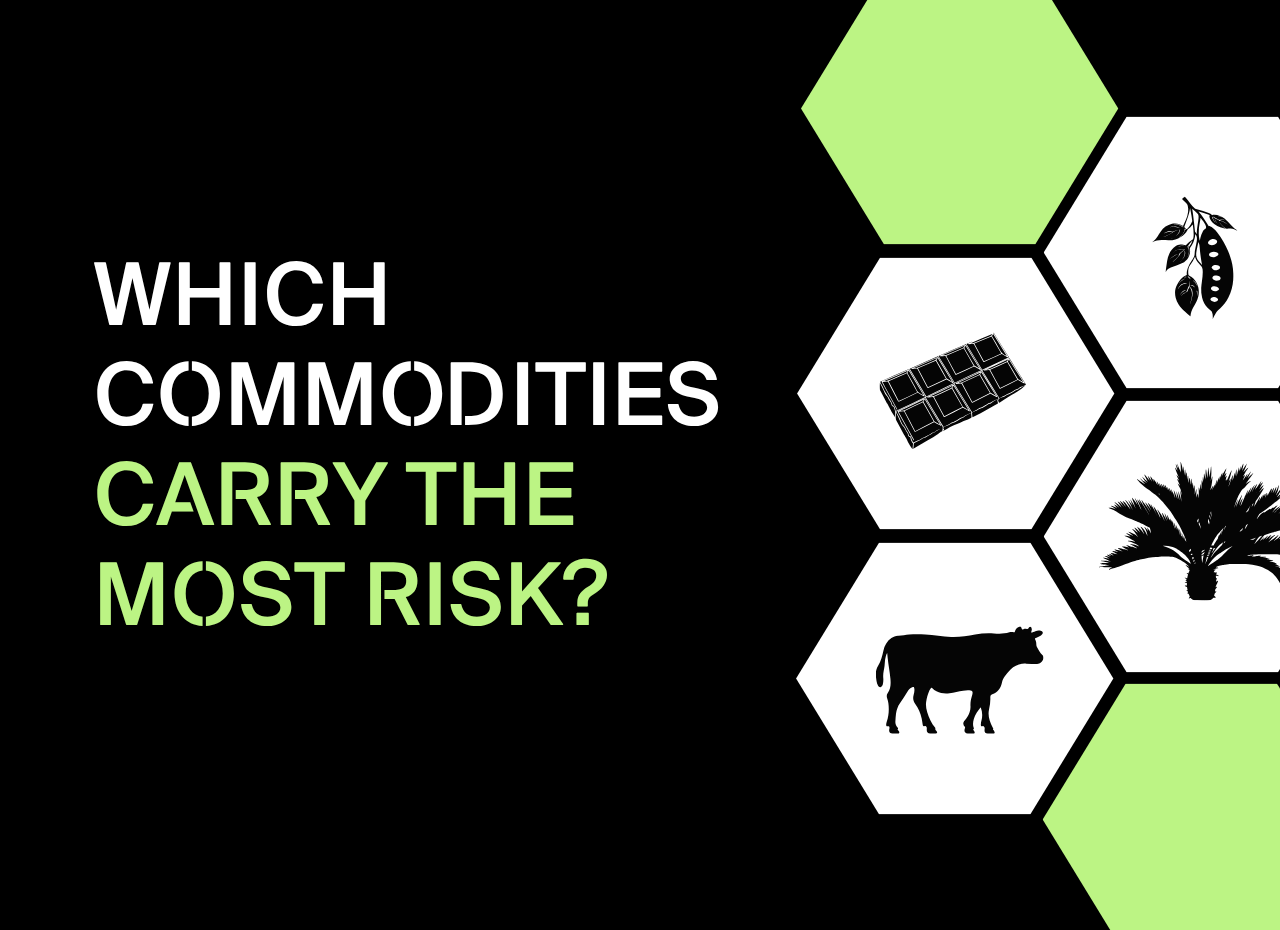
Big four. Beef, soy, palm, and cocoa carry the largest red flags. Each is closely linked to the conversion of forests and other carbon sinks into agricultural land, and each shows up heavily in consumer supply chains:
- • Beef drives the most tropical deforestation of any commodity, concentrated in South America.
- • Soy is both a direct deforestation driver and an indirect one, given its role in animal feed.
- • Palm is tied to tropical deforestation and peatland drainage across Southeast Asia, and it's in a huge share of packaged food and personal care products.
- • Cocoa is linked to forest loss in West Africa and sits in every confectionery supply chain.
Watch list. Several other commodities are worth monitoring if you buy them at scale: coffee, rubber, sugarcane, corn, rice, cotton, timber, and pulp/paper. For paper and packaging specifically, the land question is where the fiber was grown and whether that land was recently converted, the same land-use-change lens, applied to wood and pulp sourcing.
A rule of thumb: the closer a commodity is linked to tropical deforestation, peatland drainage, or conversion of native ecosystems, the more likely it is to be a material driver of land-use-change emissions in your inventory.
Why location matters as much as the crop
Most commodity risk lists stop at the crop. The location matters just as much. It's not enough to evaluate high-risk crops; you have to evaluate high-risk locations.
A commodity that's generally considered low-risk can become a serious carbon and regulatory liability the moment it's sourced from an active deforestation front or a sensitive biome. The crop didn't change; the land did. A "safe" commodity grown on recently converted land carries the emissions of that conversion, regardless of its global average profile.
This is why a commodity-only view of your supply chain isn't enough. Two shipments of the same crop can carry very different land-use-change footprints depending entirely on where they were grown. The location is doing as much work as the commodity, sometimes more.
To see this geographic split in action, look at soy. If your brand sources soy protein isolated from long-established agricultural lands in the US Midwest, your land-use change emissions footprint is virtually zero because that land was converted over a century ago. However, if you source the exact same volume of soy from an active agricultural frontier in the South American Cerrado, the carbon debt from recent native vegetation clearance gets baked directly into your ingredients. Same crop, same functional performance in your product—but a massive difference in your carbon inventory.
What can you do to reduce land-use-change emissions?
Three levers matter most:
Source from land without recent conversion. The cleanest way to lower your land-use-change number is to source commodities grown on land that wasn't recently converted from a natural ecosystem. This is where traceability pays off directly, knowing the origin lets you choose, and prove, lower-impact supply.
Improve yields on existing land. Often called sustainable intensification, getting more output from land already in production reduces the pressure to convert new land. It's one of the few levers that addresses both direct and indirect land-use change at once. For consumer brands that don't own the acres, this lever is pulled through procurement strategy: transitioning to long-term supplier contracts that give farmers the financial security to invest in high-yield regenerative practices, or actively supporting regional agronomy programs that improve local soil health.
Support restoration. Backing restoration of degraded land helps rebuild carbon storage and ecosystem function, and contributes to removals where they can be credibly measured and tracked.
Can better sourcing lower your reported number?
Not automatically. Under the new Standard, a company sourcing genuinely better, certified deforestation-free, lower-conversion supply, can still report the same land-use-change number as a company that isn't, if it can't trace that supply down to the land. The statistical method works off the commodity and the location's average, not your specific sourcing decisions. Certification on its own doesn't lower the calculated figure.
To get quantitative credit for better sourcing, you need traceability to the source. That's the work, and it's also the opportunity. The companies building that traceability now are the ones who'll be able to turn better sourcing from a claim into a measured, defensible reduction.
Open questions we're still working through
Land-use-change accounting is new, and some questions don't have settled answers yet:
- • Whose responsibility is it? When land-use change happens in a shared supply chain, who accounts for it, the farmer, the trader, the manufacturer, the retailer, or all of them? Attribution across the chain isn't fully settled.
- • Can we quantify the land use change benefits of source-reduction activities? For example, reducing or upcycling food waste means getting more out of existing production, does that function like sustainable intensification and ease land-conversion pressure? The connection is intuitive but we haven’t seen clear guidance on defensible accounting.
- • How should certification factor in methodologically? Under the direction the Standard is heading, certification is best viewed as supporting evidence, not a standalone reason to assign zero land-use-change emissions. Exactly how it should weigh in is still being worked out.
These are the questions we're following closely, because the answers shape whether the companies doing the right thing can demonstrate it in their numbers.
___________________________________
Planet FWD helps consumer brands account for land-use change, including indirect effects, as part of a defensible land sector inventory. If you source commodities like these and want to understand your exposure under the new Standard, talk to our team.
This is the second of a two-part series. The first piece, What You Need to Know About Land-Use Change Accounting, covers what the GHG Protocol Land Sector and Removals Standard requires, who's in scope, and how it changes your inventory.
Head of marketing
Lorem ipsum dolor sit amet, consectetur adipiscing elit. Consectetur, adipiscing elit, sed do eiusmod tempor incididunt ut lab. Lorem ipsum dolor sit amet, consectetur adipiscing elit. Lorem ipsum dolor sit amet, consectetur adipiscing elit.
This is an example blog post style
Lorem ipsum dolor sit amet, consectetur adipiscing elit, sed do eiusmod tempor incididunt ut labore et dolore magna aliqua. Sed vulputate odio ut enim. Volutpat sed cras ornare arcu dui. Lorem dolor sed viverra ipsum. Luctus accumsan tortor posuere ac ut consequat semper. Viverra justo nec ultrices dui sapien eget mi proin. Mollis nunc sed id semper risus in hendrerit gravida rutrum. Lacinia quis vel eros donec. Nisi vitae suscipit tellus mauris a diam. Ac orci phasellus egestas tellus rutrum tellus pellentesque eu tincidunt. Morbi quis commodo odio aenean sed adipiscing diam. Urna duis convallis convallis tellus id interdum. Tortor vitae purus faucibus ornare suspendisse sed. Vehicula ipsum a arcu cursus vitae congue. Enim sed faucibus turpis in. Orci eu lobortis elementum nibh tellus molestie nunc non blandit.
Nunc id cursus metus aliquam eleifend mi in. A erat nam at lectus urna duis convallis convallis. Tristique senectus et netus et malesuada fames ac. Id interdum velit laoreet id donec. Egestas dui id ornare arcu odio. Gravida rutrum quisque non tellus orci ac auctor. Malesuada fames ac turpis egestas maecenas pharetra convallis. Ut diam quam nulla porttitor. Eget nunc lobortis mattis aliquam faucibus purus. Aenean sed adipiscing diam donec adipiscing tristique risus nec. Nisi est sit amet facilisis magna etiam tempor orci eu. Tortor posuere ac ut consequat.
“Lorem ipsum dolor sit amet, consectetur adipiscing elit”
<span class="blockquote-wrap">
<strong>Naomi</strong>
Head of marketing
</span>

This is an example blog post style
Lorem ipsum dolor sit amet, consectetur adipiscing elit, sed do eiusmod tempor incididunt ut labore et dolore magna aliqua. Sed vulputate odio ut enim. Volutpat sed cras ornare arcu dui. Lorem dolor sed viverra ipsum. Luctus accumsan tortor posuere ac ut consequat semper. Viverra justo nec ultrices dui sapien eget mi proin. Mollis nunc sed id semper risus in hendrerit gravida rutrum. Lacinia quis vel eros donec. Nisi vitae suscipit tellus mauris a diam. Ac orci phasellus egestas tellus rutrum tellus pellentesque eu tincidunt. Morbi quis commodo odio aenean sed adipiscing diam. Urna duis convallis convallis tellus id interdum. Tortor vitae purus faucibus ornare suspendisse sed. Vehicula ipsum a arcu cursus vitae congue. Enim sed faucibus turpis in. Orci eu lobortis elementum nibh tellus molestie nunc non blandit.
<span class="rtb-protip">
<span class="rtb-protip-title"></span>
<span class="rtb-protip-body">Lorem ipsum dolor sit amet, consectetur adipiscing elit, sed do eiusmod tempor incididunt ut labore et dolore magna aliqua. Ut enim ad minim.</span></span>
How to customize formatting for each rich text
- Lorem ipsum dolor sit amet, consectetur adipiscing elit sed do eiusmod
- Lorem ipsum dolor sit amet, consectetur adipiscing elit sed do eiusmod
- Lorem ipsum dolor sit amet, consectetur adipiscing elit sed do eiusmod
- Lorem ipsum dolor sit amet, consectetur adipiscing elit sed do eiusmod
Headings, paragraphs, blockquotes, figures, images, and figure captions can all be styled after a class is added to the rich text element using the "When inside of" nested selector system.
Static and dynamic content editing
A rich text element can be used with static or dynamic content. For static content, just drop it into any page and begin editing. For dynamic content, add a rich text field to any collection and then connect a rich text element to that field in the settings panel. Voila!
- Lorem ipsum dolor sit amet, consectetur adipiscing elit sed do eiusmod
- For static content, just drop it into any page and begin editing. For static content, just drop it into any page and begin editing.
- Lorem ipsum dolor sit amet, consectetur adipiscing
How to customize formatting for each heading
Headings, paragraphs, blockquotes, figures, images, and figure captions can all be styled after a class is added to the rich text element using the "When inside of" nested selector system.