Sephora Planet Aware: What the Seal Requires
Sephora's Planet Aware seal is rare. Sephora launched the program in April 2024, but only around 25 brands across Sephora's North American storefronts carry it today, out of more than 350 brands on the platform. Despite this, more than a quarter of Sephora's EU and US sales now come from products carrying its sustainability seals, the Planet Aware seal among them. For a beauty brand selling through Sephora, that combination of rarity and retail visibility has made Planet Aware worth understanding closely. This is what the seal asks for, where most brands hit a wall, and how to clear the bar.
What Planet Aware is
Planet Aware is Sephora's most rigorous sustainability seal. Sephora built it with external environmental and scientific experts over two years. The standard sits across four pillars and 32 mandatory criteria.
The four pillars:
- Sustainable Ingredient Sourcing & Formula
- Sustainable Packaging
- Corporate Commitments & Practices
- Consumer Information & Environmental Labeling
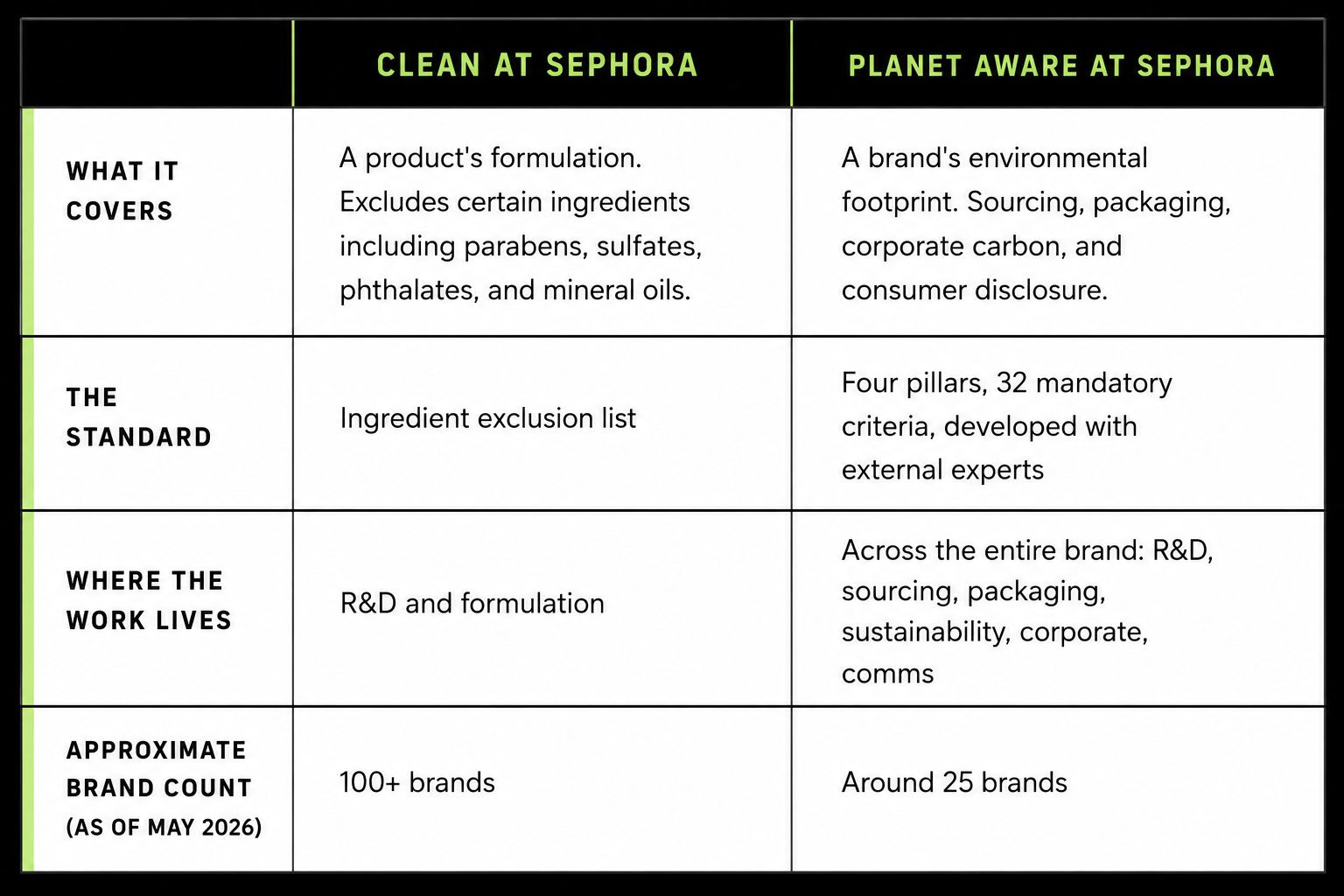
A brand has to meet every mandatory criterion (Must-Have) across all four pillars to qualify. The program also has Additional criteria, where a brand picks a target number to hit, but the Must-Haves are the gating bar.
Pillars 1 and 2 are largely operational: The brand decides which ingredients to use, how to source palm oil and mica, how to design packaging, and what recycled content to include. These decisions sit inside the brand's existing supply chain and formulation teams.
Pillars 3 and 4 are where the work changes shape, and where a brand might not have the operational ability to meet the requirements internally.
Where most brands hit a wall: Pillar 3's carbon Must-Haves
Pillar 3 covers Corporate Commitments & Practices. It includes operational items like supplier audits and energy use, but the Must-Haves under this pillar are carbon-measurement requirements:
- All brands: have calculated Scope 1 and Scope 2 emissions.
- Large brands (large independents and brands within large multi-brand parent companies): have also calculated Scope 3 emissions.
- Large brands: have set reduction targets for at least Scope 1 and 2, with a planned date for Scope 3 targets, verified by a third party.
Calculating Scope 1 and 2 is reasonably contained. Scope 1 is direct emissions from owned operations. Scope 2 is purchased electricity. A beauty brand with a small footprint might be able to pull these from energy bills and facility data, but there’s still the matter of translating how much energy you purchase into how much emissions you generate.
Scope 3 is where the lift gets even heavier. Scope 3 is emissions from everything else: ingredients, packaging materials, manufacturing done by contract manufacturers, distribution, retail energy, consumer use, and end-of-life. For most beauty brands, Scope 3 accounts for the majority of the footprint, often more than 90%. It is also the category Sephora is asking large brands to measure.
Building a credible Scope 3 inventory means going line by line through the supply chain. Every ingredient. Every packaging component. Every step of production. Most beauty teams cannot do this in-house. The data sits with suppliers. The methodology has to follow the GHG Protocol's Corporate Standard and Scope 3 Standard
And after all of this measurement, for large companies, the pillar also requires setting carbon reduction targets.
Traditional sustainability consultancies typically deliver a Scope Inventory that meets these requirements in six to nine months, at high five-figure budgets, with a slide deck at the end.
Pillar 4's environmental disclosure piece
Pillar 4 is Consumer Information & Environmental Labeling. The Must-Haves here are different from Pillar 3.
A brand must provide consumers at least two of eight types of environmental information. The eight are:
- Ingredient traceability
- Environmental scoring (a synthetic environmental impact score)
- Carbon emissions
- Packaging materials
- Production location
- Sustainable material content (recycled or biobased)
- Certifications
- Recycling instructions
A brand must also provide recycling instructions on every SKU.
Carbon emissions is one of the eight disclosure types Sephora lists. A brand can satisfy Pillar 4 by disclosing, say, ingredient traceability and recycling instructions, without any carbon labeling at all. However, the criteria do note that brands should be working toward all eight over time, so carbon disclosure is on the trajectory and may become a requirement in future years, even when it is not mandatory at qualification.
The implication for a brand pursuing Planet Aware: Pillar 4 is about which disclosures the brand chooses to publish to consumers. Some of those choices (ingredient traceability, production location) sit inside the brand. The carbon emissions disclosure depends on product-level carbon data, which most brands build alongside their Pillar 3 corporate inventory rather than separately.
Why this matters to customers
Customers actively look for sustainability credentials when they shop beauty. ClimatePartner reports that 65% of Millennial and Gen Z consumers are willing to pay more for eco-conscious products, 87% research a brand's sustainability credentials before purchasing, and 68% rely on trusted third-party certifications to identify clean and sustainable products.
Planet Aware is that third-party signal. Sephora sets the criteria. Sephora reviews the work. A brand earns the seal by passing those reviews.
For the brand, the seal turns sustainability work into a visible asset on Sephora's site, on product photos, and in the customer's decision moment.
Where Planet FWD fits
Planet FWD delivers the carbon Must-Haves under Pillar 3, and supports Pillar 4 with the product-level carbon data that lets a brand offer carbon disclosure to consumers.
For Pillar 3:
- - Corporate carbon inventory across Scope 1, 2, and 3, calculated using GHG Protocol-aligned methodology with documented system boundaries.
- - Target setting and the methodology that holds up to third-party verification.
For Pillar 4:
- - Product Carbon Footprints conformant with PACT v3, the cross-industry methodology standard used for retailer scorecards. These give a brand the carbon disclosure for its SKUs, which is one of the eight qualifying Pillar 4 information types.
The reason a brand might pick a software platform over a traditional consultancy here is speed and reusability. The carbon Must-Haves are delivered in roughly eight weeks rather than six to nine months, anchored by an ingredient and materials database broad enough to handle what beauty brands formulate with. That same database is what makes activity-based Scope 3 measurable at the ingredient level. And the data is reusable. The same data infrastructure serves CDP reporting, SBTi target submissions, B Corp recertification, SB 253 disclosure, EPR compliance, and R&D decisions through comparison LCAs that inform reformulation and packaging changes before launch. One build, multiple use cases.
Doing it well
Two things separate a Planet Aware-ready carbon program from a check-the-box exercise.
First, primary supplier data for the categories that drive the footprint. For most beauty products, that means ingredients and packaging. Secondary emissions factors (industry averages) work for the long tail of spend, but the 10 to 20% of spend that drives the majority of emissions deserves direct supplier data. Verifiers expect to see it.
Second, documented system boundaries and methodology choices. The GHG Protocol gives brands flexibility on cut-off rules, allocation methods, and category inclusions. Whichever choices a brand makes, they have to be documented and consistent. A third-party reviewer will check them.
Sephora's Planet Aware standard is what it is, in part, because Sephora built it independently with external experts. The credibility of the seal travels back to the brand that earns it.
Frequently asked questions
What is Sephora Planet Aware? Planet Aware is Sephora's highest-bar sustainability seal, launched in April 2024. It sits across four pillars and 32 mandatory criteria covering ingredient sourcing, packaging, corporate carbon commitments, and consumer environmental information. Around 25 brands carry the seal today.
How does a brand qualify for Planet Aware? A brand must meet every mandatory criterion (Must-Have) across all four pillars. The criteria were developed by Sephora with external environmental and scientific experts over two years. Brands also pick a target number of Additional criteria to meet, but the Must-Haves are the gating bar.
What carbon data does Planet Aware require? All brands must have calculated Scope 1 and Scope 2 emissions. Large brands (large independents and brands within large multi-brand parent companies) must also have calculated Scope 3 emissions, plus third-party-verified reduction targets for at least Scope 1 and 2, with a planned date for Scope 3 targets.
Is product carbon labeling required for Planet Aware? No. Product carbon labeling is one of eight environmental information types under Pillar 4. A brand must disclose at least two of the eight to consumers. The criteria say brands should be working toward all eight over time, so carbon disclosure is on the trajectory even when it is not mandatory at qualification.
How long does Planet Aware preparation take? The carbon Must-Haves under Pillar 3 typically take six to nine months through a traditional sustainability consultancy. Planet FWD delivers the same scope in roughly eight weeks. Total preparation time depends on how much of the operational work (Pillars 1 and 2) the brand has already done.
How does Planet FWD support a Planet Aware application? Planet FWD delivers the Pillar 3 carbon Must-Haves: Scope 1-3 corporate inventory, GHG Protocol-aligned methodology, and target setting that holds up to third-party verification. Planet FWD also provides Product Carbon Footprints conformant with PACT v3, which gives a brand the carbon-emissions disclosure option under Pillar 4.
Where to start
For brands considering Planet Aware, the first step is usually a 30-minute working session: where the brand's carbon data stands today, what Pillar 3 will require given the brand's size and ownership structure, and a realistic timeline before submission. We do this with beauty brands across categories and price points. No deck. No pitch.
Book a 30-minute scoping call
Head of marketing
Lorem ipsum dolor sit amet, consectetur adipiscing elit. Consectetur, adipiscing elit, sed do eiusmod tempor incididunt ut lab. Lorem ipsum dolor sit amet, consectetur adipiscing elit. Lorem ipsum dolor sit amet, consectetur adipiscing elit.
This is an example blog post style
Lorem ipsum dolor sit amet, consectetur adipiscing elit, sed do eiusmod tempor incididunt ut labore et dolore magna aliqua. Sed vulputate odio ut enim. Volutpat sed cras ornare arcu dui. Lorem dolor sed viverra ipsum. Luctus accumsan tortor posuere ac ut consequat semper. Viverra justo nec ultrices dui sapien eget mi proin. Mollis nunc sed id semper risus in hendrerit gravida rutrum. Lacinia quis vel eros donec. Nisi vitae suscipit tellus mauris a diam. Ac orci phasellus egestas tellus rutrum tellus pellentesque eu tincidunt. Morbi quis commodo odio aenean sed adipiscing diam. Urna duis convallis convallis tellus id interdum. Tortor vitae purus faucibus ornare suspendisse sed. Vehicula ipsum a arcu cursus vitae congue. Enim sed faucibus turpis in. Orci eu lobortis elementum nibh tellus molestie nunc non blandit.
Nunc id cursus metus aliquam eleifend mi in. A erat nam at lectus urna duis convallis convallis. Tristique senectus et netus et malesuada fames ac. Id interdum velit laoreet id donec. Egestas dui id ornare arcu odio. Gravida rutrum quisque non tellus orci ac auctor. Malesuada fames ac turpis egestas maecenas pharetra convallis. Ut diam quam nulla porttitor. Eget nunc lobortis mattis aliquam faucibus purus. Aenean sed adipiscing diam donec adipiscing tristique risus nec. Nisi est sit amet facilisis magna etiam tempor orci eu. Tortor posuere ac ut consequat.
“Lorem ipsum dolor sit amet, consectetur adipiscing elit”
<span class="blockquote-wrap">
<strong>Naomi</strong>
Head of marketing
</span>

This is an example blog post style
Lorem ipsum dolor sit amet, consectetur adipiscing elit, sed do eiusmod tempor incididunt ut labore et dolore magna aliqua. Sed vulputate odio ut enim. Volutpat sed cras ornare arcu dui. Lorem dolor sed viverra ipsum. Luctus accumsan tortor posuere ac ut consequat semper. Viverra justo nec ultrices dui sapien eget mi proin. Mollis nunc sed id semper risus in hendrerit gravida rutrum. Lacinia quis vel eros donec. Nisi vitae suscipit tellus mauris a diam. Ac orci phasellus egestas tellus rutrum tellus pellentesque eu tincidunt. Morbi quis commodo odio aenean sed adipiscing diam. Urna duis convallis convallis tellus id interdum. Tortor vitae purus faucibus ornare suspendisse sed. Vehicula ipsum a arcu cursus vitae congue. Enim sed faucibus turpis in. Orci eu lobortis elementum nibh tellus molestie nunc non blandit.
<span class="rtb-protip">
<span class="rtb-protip-title"></span>
<span class="rtb-protip-body">Lorem ipsum dolor sit amet, consectetur adipiscing elit, sed do eiusmod tempor incididunt ut labore et dolore magna aliqua. Ut enim ad minim.</span></span>
How to customize formatting for each rich text
- Lorem ipsum dolor sit amet, consectetur adipiscing elit sed do eiusmod
- Lorem ipsum dolor sit amet, consectetur adipiscing elit sed do eiusmod
- Lorem ipsum dolor sit amet, consectetur adipiscing elit sed do eiusmod
- Lorem ipsum dolor sit amet, consectetur adipiscing elit sed do eiusmod
Headings, paragraphs, blockquotes, figures, images, and figure captions can all be styled after a class is added to the rich text element using the "When inside of" nested selector system.
Static and dynamic content editing
A rich text element can be used with static or dynamic content. For static content, just drop it into any page and begin editing. For dynamic content, add a rich text field to any collection and then connect a rich text element to that field in the settings panel. Voila!
- Lorem ipsum dolor sit amet, consectetur adipiscing elit sed do eiusmod
- For static content, just drop it into any page and begin editing. For static content, just drop it into any page and begin editing.
- Lorem ipsum dolor sit amet, consectetur adipiscing
How to customize formatting for each heading
Headings, paragraphs, blockquotes, figures, images, and figure captions can all be styled after a class is added to the rich text element using the "When inside of" nested selector system.