Why carbon data arrives too late
Most beauty brands run their first Product Carbon Footprint after the product is already on shelf. Perhaps a retailer asks for the data, a marketing claim needs backing, or a sustainability report has a gap. The brand commissions an LCA, waits a few months, and gets a number back.
The number may be accurate, but it is also too late to act on.
By the time a finished product gets measured, the decisions that shaped its footprint are locked: the emollient was chosen eighteen months ago, the bottle was tooled, the supplier contracts are signed. The carbon data arrives, points clearly at the ingredient or the package driving most of the impact, and the team has no practical way to act on it without reopening work that is already done. Even then, it will be months or even years before those reduction decisions make it to market.
Most brands treat carbon data as a reporting output, generated at the end to satisfy a requirement and record decisions the brand has already made.
But the most useful moment for carbon data is earlier, while the choices are still your team's to make.
What an LCA comparison is
An LCA comparison places two or more life cycle assessments side by side to show which product option has the lower carbon footprint and where the difference comes from.
A standard product LCA measures one product. It traces the carbon and environmental impact of a single formulation across its life cycle, from raw materials through manufacturing, distribution, consumer use, and end of life. It answers one question: what is this product's footprint.
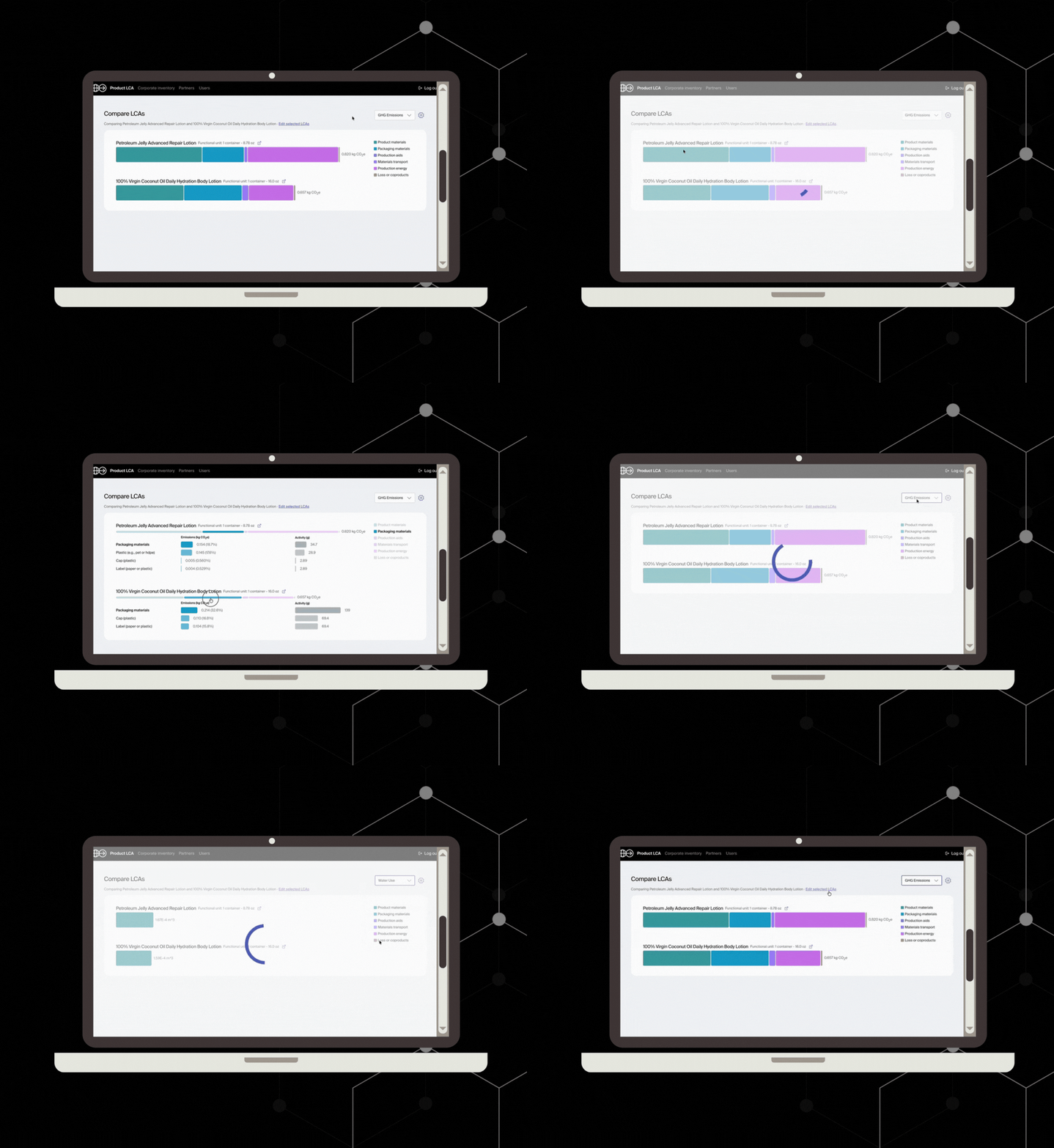
An LCA comparison answers a different question: which option is better, and by how much. That is the question a beauty R&D team needs answered. The comparison shows the difference by life cycle stage, then lets a team drill into what is driving it: materials, packaging, energy. A variant view highlights what moves when the product changes, so a team can model a reformulation and see the carbon effect of the swap directly.
A brand can compare its own product options against each other, two emollients, two bottle formats, a full-size liquid next to a concentrate. It can also compare a product against an industry reference, to see how the brand's footprint sits relative to a typical product in the category.
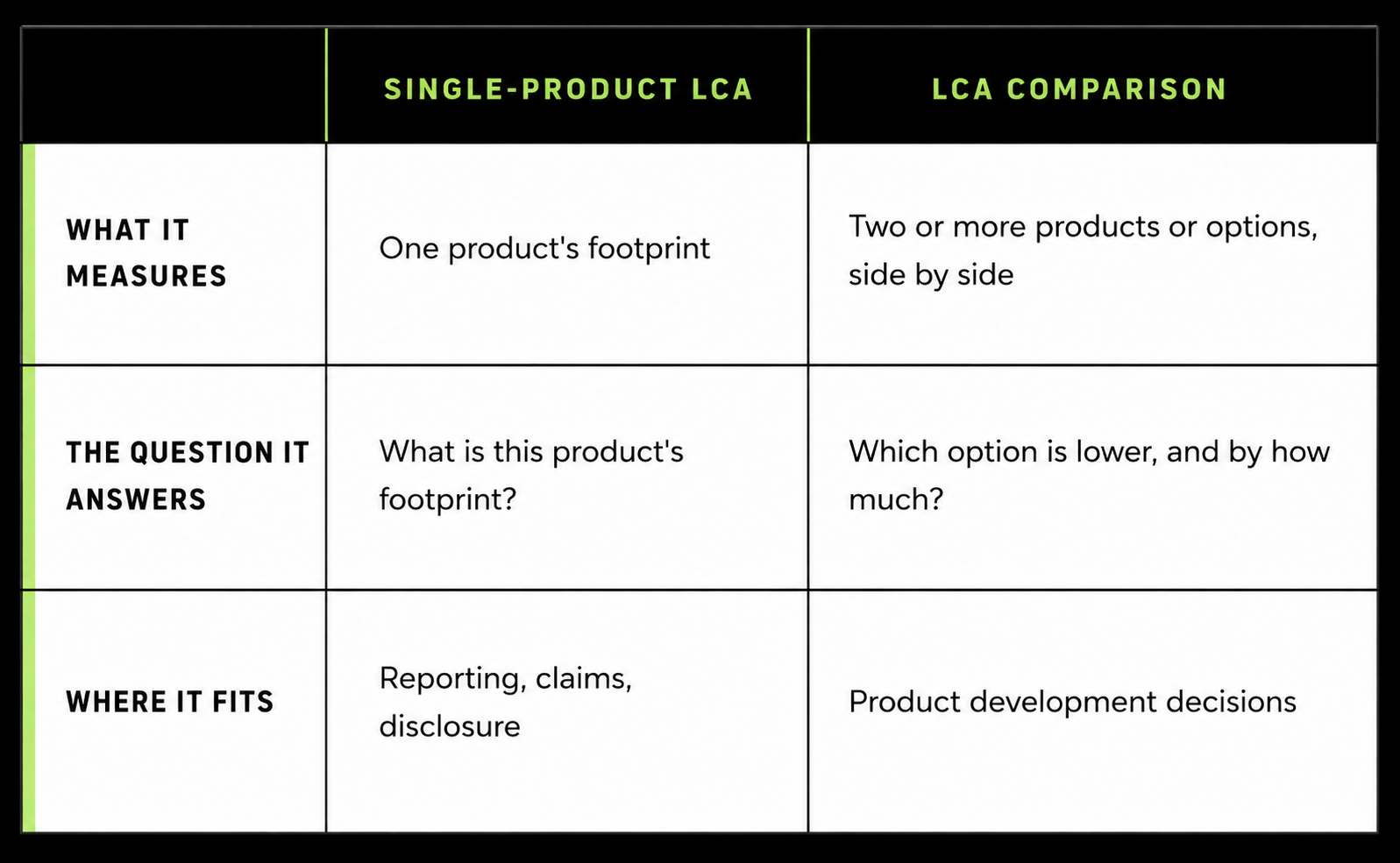
One note on terms. Comparing LCAs to inform your own product decisions or understand where you might stand compared to a theoretical benchmark product is a decision-support tool. Claiming publicly that your product is environmentally better than a competitor's is a comparative assertion, and ISO 14044 sets a higher bar for that, including an independent critical review (following ISO 14070) before the claim is disclosed. This article is about the first use, the internal decision.
Where it changes beauty R&D decisions
The value of an LCA comparison shows up in the specific decisions a beauty R&D team makes, here are 5 examples:
Ingredient selection. Two emollients can deliver a similar sensory result with very different carbon profiles. A plant-derived ingredient is not automatically lower-impact than a synthetic one. Agricultural inputs, land use, and processing energy all carry weight, and a comparison sometimes finds the natural option carries a higher footprint than the synthetic. Putting the two side by side turns an assumption into a measured decision.
Packaging format. Packaging is a significant contributor to most beauty products' footprints, and the options vary widely. Glass, recycled plastic, aluminum, and refillable formats each carry a different impact. An LCA comparison models the bottle decision before tooling, when changing it still costs very little.
Sourcing and transport. Where an ingredient is grown or processed, and how it travels, changes its footprint. A comparison can weigh a closer supplier against a lower-cost one, or a sea route against air freight, with the carbon trade-off visible.
Product format. A full-size liquid, a concentrate, and a solid bar are three carbon profiles for the same product function. Concentrates and bars cut water weight and shipping volume. An LCA comparison quantifies the difference so a format decision is grounded in data.
Validating decisions already made. Some brands have already chosen recycled plastic packaging, bioplastics, regenerative ingredients, or a refill system. A comparison LCA can quantify what those choices avoided. Build a counterfactual using the conventional alternative (virgin fossil plastic, the standard ingredient, single-use packaging) and compare the current product against it. The delta is the carbon impact the brand's choice prevented relative to that alternative. That number becomes part of the brand story for investors, retailers, and consumers.
Across these five examples, the deeper shift for an R&D team is what a reduction effort should target in the first place. An LCA comparison can show that swapping a single ingredient moves the number very little, while changing the packaging format or shifting from liquid to concentrate moves it far more. Without the comparison, a team can spend a full development cycle optimizing the part of the footprint that barely matters.
Why beauty brands are doing this now
Most beauty brands measuring carbon today are not doing it because a law requires it. The pressure comes from the market, with retailers at the front of it.
Sephora's Planet Aware program, Ulta's Conscious Beauty, and Amazon Climate Pledge programs are voluntary, but they shape which products get visibility and placement. Beyond the formal programs, retailers send sustainability questionnaires directly to brands. When the questionnaire comes from a retailer that controls your shelf space, you prioritize the answer as if it were a requirement.
Consumer demand reinforces it. For brands like amika that are built on environmental positioning, the customer base chose the brand for those values, and formulation, ingredient sourcing, and packaging have to match what the brand has told its audience.
Investors and acquirers add another layer when a brand is raising capital or preparing for an exit. For the largest brands, regulation enters the picture too, with California's SB 253 and packaging EPR rules already in force and more states following.
A beauty brand is likely building carbon data for one of these reasons. An LCA comparison is a small step from there, and the data that answers a retailer's questionnaire can inform a product decision before the next launch.
The compounding advantage
A single carbon dataset can do a lot of work. The product LCAs a brand builds for one purpose carry over to the others.
The same data supports retailer credentials like Sephora Planet Aware and Ulta Conscious Beauty. It backs on-pack and online carbon claims. It feeds corporate Scope 3 reporting. It answers the customer and retailer questionnaires that arrive every season. And it informs R&D, through the comparisons described above.
A brand that sets this up early builds its carbon data once and draws on it repeatedly. Each new use costs less than the last.
LCA comparisons sit inside that foundation. A brand already measuring its products for a retailer program has most of what a comparison needs. Turning that data into an R&D tool is a small additional step.
Doing it well
An LCA comparison is only as good as the LCAs behind it and the way they are compared. A few things separate a comparison a team can act on from one that misleads.
Speed.
Decision-stage data has to arrive while the decision is still open. A comparison that takes six months is a report. For R&D, it has to keep pace with the development calendar.
Methodology.
The underlying LCAs should follow a recognized standard, ISO 14040 for LCA, so the same data holds up later when a retailer or an auditor reviews it. A comparison built on a loose method gives an answer the team cannot defend.
Consistency.
The LCAs being compared have to share the same boundaries and the same functional unit. Comparing two assessments built on different assumptions produces a difference that is not real.
Data quality.
A comparison is only as trustworthy as the emissions factors behind it. A platform that matches the specific ingredients and materials a beauty product uses produces a comparison a formulator can trust. Category averages produce one that washes out the differences that matter.
Scenario modeling.
The analysis has to let a team change an input, an ingredient, a package, a route, and see how the result moves. That capability is what makes a comparison a decision tool.
One system.
When the LCA comparisons, the product footprints, and the corporate inventory draw on the same data, the work compounds. Separate tools mean every analysis starts from scratch
Frequently asked questions
What is an LCA comparison? An LCA comparison places two or more life cycle assessments side by side to show which product, or which product option, has the lower carbon footprint, and which life cycle stages drive the difference. Beauty R&D teams use it to weigh formulation, packaging, and sourcing options during development.
How is an LCA comparison different from a comparative assertion? An LCA comparison is an internal decision-support tool. A comparative assertion is a public claim that one product is environmentally better than a competing product. ISO 14044 requires an independent critical review before a comparative assertion is disclosed to the public.
What stage of a beauty product's life cycle has the largest carbon footprint? It depends on the product. For rinse-off products such as shampoo and body wash, the consumer use phase often dominates, driven by the energy to heat rinse water. For leave-on products such as creams and serums, raw materials usually carry the largest share.
When should a beauty brand run an LCA comparison? During product development, while the formulation, packaging, and sourcing decisions are still open. A comparison run after the product ships can describe the footprint, but the decisions that shaped it are already locked.
Do beauty brands need carbon data if they are not legally required to report it? Many do. Retailers including Sephora and Ulta ask brands for sustainability data, and consumers and investors increasingly expect it. That pressure reaches brands that sit below mandatory reporting thresholds.
What makes an LCA comparison reliable? The underlying LCAs should follow a recognized standard such as ISO 14040, share the same system boundaries and functional unit, and use ingredient-specific emissions factors rather than category averages.
Where to start
Carbon data earns its cost when it changes a decision.
The cheapest moment to bring it into a beauty product is while the product is still being designed. An LCA comparison at that stage costs a fraction of a reformulation later, and it gives the team the data to choose well the first time.
If you have a product in development, a 30-minute scoping call with Steven maps your current data to an LCA comparison timeline.
Book a Scoping Call
Head of marketing
Lorem ipsum dolor sit amet, consectetur adipiscing elit. Consectetur, adipiscing elit, sed do eiusmod tempor incididunt ut lab. Lorem ipsum dolor sit amet, consectetur adipiscing elit. Lorem ipsum dolor sit amet, consectetur adipiscing elit.
This is an example blog post style
Lorem ipsum dolor sit amet, consectetur adipiscing elit, sed do eiusmod tempor incididunt ut labore et dolore magna aliqua. Sed vulputate odio ut enim. Volutpat sed cras ornare arcu dui. Lorem dolor sed viverra ipsum. Luctus accumsan tortor posuere ac ut consequat semper. Viverra justo nec ultrices dui sapien eget mi proin. Mollis nunc sed id semper risus in hendrerit gravida rutrum. Lacinia quis vel eros donec. Nisi vitae suscipit tellus mauris a diam. Ac orci phasellus egestas tellus rutrum tellus pellentesque eu tincidunt. Morbi quis commodo odio aenean sed adipiscing diam. Urna duis convallis convallis tellus id interdum. Tortor vitae purus faucibus ornare suspendisse sed. Vehicula ipsum a arcu cursus vitae congue. Enim sed faucibus turpis in. Orci eu lobortis elementum nibh tellus molestie nunc non blandit.
Nunc id cursus metus aliquam eleifend mi in. A erat nam at lectus urna duis convallis convallis. Tristique senectus et netus et malesuada fames ac. Id interdum velit laoreet id donec. Egestas dui id ornare arcu odio. Gravida rutrum quisque non tellus orci ac auctor. Malesuada fames ac turpis egestas maecenas pharetra convallis. Ut diam quam nulla porttitor. Eget nunc lobortis mattis aliquam faucibus purus. Aenean sed adipiscing diam donec adipiscing tristique risus nec. Nisi est sit amet facilisis magna etiam tempor orci eu. Tortor posuere ac ut consequat.
“Lorem ipsum dolor sit amet, consectetur adipiscing elit”
<span class="blockquote-wrap">
<strong>Naomi</strong>
Head of marketing
</span>

This is an example blog post style
Lorem ipsum dolor sit amet, consectetur adipiscing elit, sed do eiusmod tempor incididunt ut labore et dolore magna aliqua. Sed vulputate odio ut enim. Volutpat sed cras ornare arcu dui. Lorem dolor sed viverra ipsum. Luctus accumsan tortor posuere ac ut consequat semper. Viverra justo nec ultrices dui sapien eget mi proin. Mollis nunc sed id semper risus in hendrerit gravida rutrum. Lacinia quis vel eros donec. Nisi vitae suscipit tellus mauris a diam. Ac orci phasellus egestas tellus rutrum tellus pellentesque eu tincidunt. Morbi quis commodo odio aenean sed adipiscing diam. Urna duis convallis convallis tellus id interdum. Tortor vitae purus faucibus ornare suspendisse sed. Vehicula ipsum a arcu cursus vitae congue. Enim sed faucibus turpis in. Orci eu lobortis elementum nibh tellus molestie nunc non blandit.
<span class="rtb-protip">
<span class="rtb-protip-title"></span>
<span class="rtb-protip-body">Lorem ipsum dolor sit amet, consectetur adipiscing elit, sed do eiusmod tempor incididunt ut labore et dolore magna aliqua. Ut enim ad minim.</span></span>
How to customize formatting for each rich text
- Lorem ipsum dolor sit amet, consectetur adipiscing elit sed do eiusmod
- Lorem ipsum dolor sit amet, consectetur adipiscing elit sed do eiusmod
- Lorem ipsum dolor sit amet, consectetur adipiscing elit sed do eiusmod
- Lorem ipsum dolor sit amet, consectetur adipiscing elit sed do eiusmod
Headings, paragraphs, blockquotes, figures, images, and figure captions can all be styled after a class is added to the rich text element using the "When inside of" nested selector system.
Static and dynamic content editing
A rich text element can be used with static or dynamic content. For static content, just drop it into any page and begin editing. For dynamic content, add a rich text field to any collection and then connect a rich text element to that field in the settings panel. Voila!
- Lorem ipsum dolor sit amet, consectetur adipiscing elit sed do eiusmod
- For static content, just drop it into any page and begin editing. For static content, just drop it into any page and begin editing.
- Lorem ipsum dolor sit amet, consectetur adipiscing
How to customize formatting for each heading
Headings, paragraphs, blockquotes, figures, images, and figure captions can all be styled after a class is added to the rich text element using the "When inside of" nested selector system.