CARB Released Its 2026 SB 253 Reporting Guidance. Here's What You Have to File by November 10.
CARB has said what counts as a report for SB 253. Four formats qualify, the eGRID 2024 gap has an answer, and limited assurance is already required for 2026, with enforcement deferred. Your first reports are due November 10.
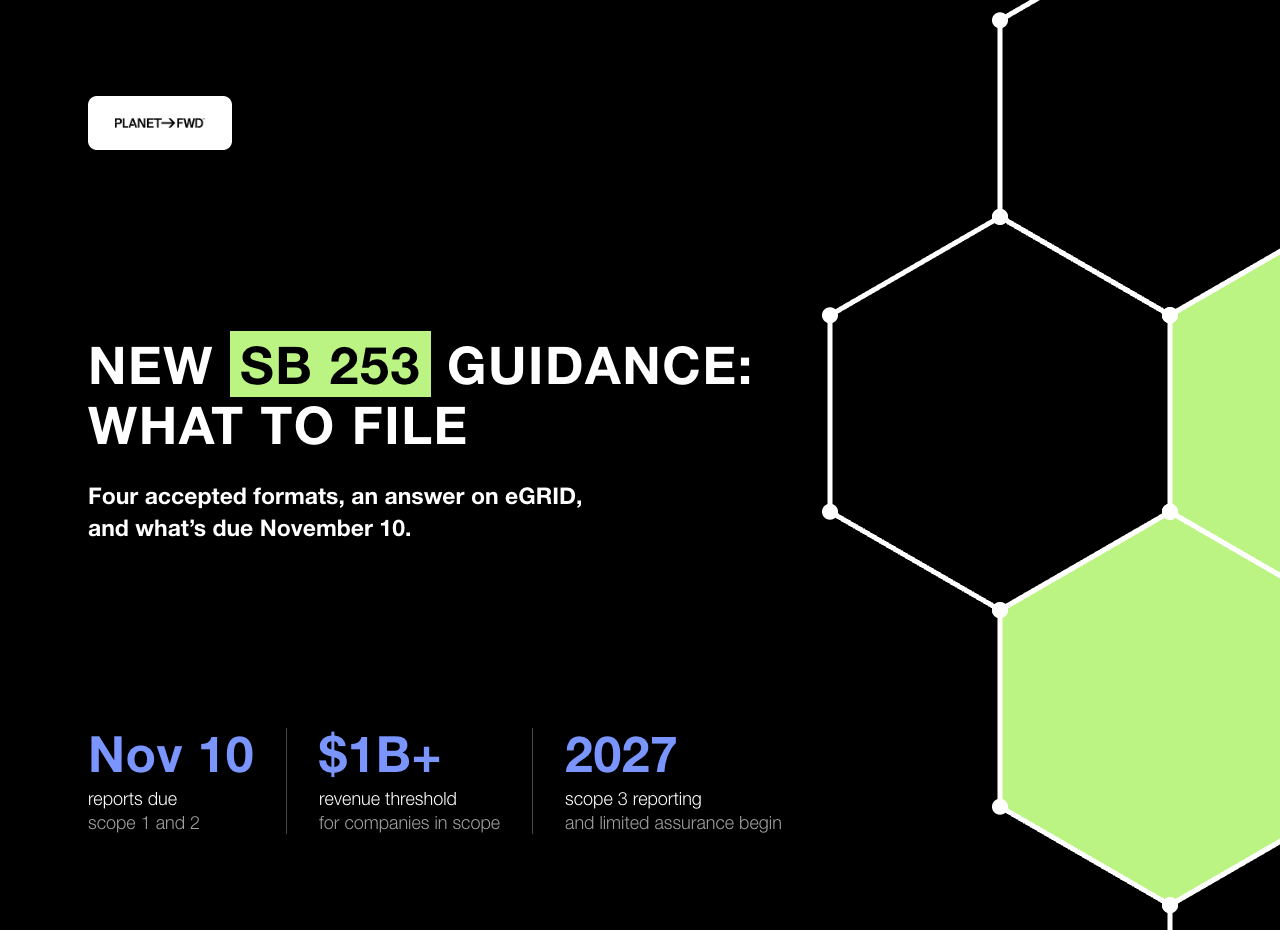
California Air Resources Board (CARB) Published First Year SB 253 Guidance
CARB has published its reporting guidance for the first year of SB 253 and opened a voluntary intake platform. Reports are due November 10, 2026, and the guidance answers the question companies have been stuck on all summer: what exactly counts as a report.
CARB will accept several formats, including reports you've already produced for something else, so the lift here is smaller than a lot of teams feared. There's also a line about public disclosure that deserves more attention than it's getting.
Where things stand, as of September 4, 2026
- Scope 1 and Scope 2 emissions for your preceding fiscal year, due on or before November 10, 2026
- The underlying regulation is still awaiting approval from the California Office of Administrative Law, and CARB's guidance is written to apply "if approved"
- CARB will accept four formats, including Its own template (use of this template is optional)
- First-year enforcement discretion applies, tied to the December 5, 2024 enforcement notice
- Everything you upload becomes public
- Fee invoices go out on or before December 10, 2026, payable within 60 days
- In scope: US-based companies with more than $1 billion in annual revenue doing business in California
What can you submit for 2026?
The guidance lists four acceptable formats.
- An existing annual report that already includes your Scope 1 and Scope 2 GHG emissions.
- Existing Scope 1 and 2 data you already report to other programs or voluntary initiatives.
- CARB's Draft Scope 1 & 2 GHG Reporting Template, posted October 10, 2025. Use of it is voluntary for the 2026 cycle.
- A statement of non-reporting, if you weren't collecting Scope 1 and Scope 2 data as of December 5, 2024. More on that below.
You can submit through CARB's voluntary intake platform or by emailing climatedisclosure@arb.ca.gov. The platform isn't required. CARB built it to streamline fee implementation and first-year reporting, and it collects the billing information CARB needs for invoicing. That's a practical reason to use it even if you send your report another way.
Which emission factors do you have to use?
No specific dataset is required, and CARB names the underlying problem directly: most reporting entities use eGRID for Scope 2 calculations, and the U.S. EPA has not released eGRID 2024 on its usual timeline.
The guidance gives you three routes:
- Use the most recent official EPA release, eGRID 2023
- Use the eGRID 2024 dataset published by the Cornerstone Sustainability Data Initiative, generated from EPA's publicly available source code
- Use an alternative credible emission factor source
Whichever you pick, CARB encourages you to identify the emission factors used and their sources.
Naming your factor source costs nothing this year, and it's exactly what an assurer will ask for in the next cycle.
Do you need assurance?
HSC section 38532 requires limited assurance beginning in 2026. The obligation is already in the statute. What's changed is enforcement: given first-year discretion, CARB will accept your submission whether or not assurance has been obtained for the 2026 cycle. So it's already a requirement, but CARB is choosing not to enforce it this cycle.
How much detail do you need to provide?
CARB asks for more detail than you might be used to providing in your voluntary reports. Reporting entities submitting reports would be required to provide annual Scope 1 and Scope 2 emissions. Beyond that, CARB encourages additional detail in the first year, "where available," because it helps qualify the numbers and provides context. The guidance names what it's looking for:
- Descriptions of methodologies
- Data sources
- Global warming potential values
- Emission factors
- Organizational boundaries
- Disaggregated emission data by category and gas
- Any assumptions used
What becomes public?
Reporting under SB 253 is a public disclosure program, and coverage of the intake platform indicates that uploaded emissions reports and statements of non-reporting will be made public. Confirm the specifics with CARB or your counsel before you file, because it changes the calculus on what you submit. Whatever number you put in goes out under your company's name, where competitors, customers, journalists and whoever writes your retailer scorecard can read it. A spend-based estimate is a reasonable thing to file this year, and CARB's own flexibility says as much. It gets harder to stand behind once you file a measured number in a later cycle and someone asks why the two don't reconcile.
There are nine weeks until November 10, and that's enough time to improve a Scope 1 and Scope 2 number if you already hold the inputs. Most companies we talk to do: utility bills, fuel purchases, refrigerant records, fleet data. Pull what you have and look at your numbers before you commit to your submission.
How should you start preparing for 2027?
Start now, and start with supplier data.
Very little about the next cycle is settled. CARB's second rulemaking covers GHG accounting methodologies, deadlines, assurance requirements, and reporting formats. There will be a 45-day comment period introduced this fall and a Board item proposed for the end of the year. Everything in the current guidance applies to 2026 reporting filings only.
One thing is already fixed, and it should drive your timeline more than the rulemaking does. Scope 3 reporting in the next cycle will cover this fiscal year.
We recommend you start requesting data from your suppliers now. Responses typically take longer than anyone plans for, and the questions get harder the longer you wait. Ask a supplier in early 2027 about a year they closed in December and you're asking them to reconstruct records, assuming the person who knew is still in the role.
FAQs
When is the SB 253 reporting deadline?
On or before November 10, 2026, for Scope 1 and Scope 2 emissions for your preceding fiscal year. The Initial Regulation is still pending approval from the Office of Administrative Law, and CARB's guidance is written to apply if that approval comes through.
What do I have to submit for SB 253 in 2026?
One of four things: an existing annual report including your Scope 1 and Scope 2 GHG emissions, existing Scope 1 and 2 data you report to another program or voluntary initiative, CARB's Draft Scope 1 & 2 Reporting Template, or a statement of non-reporting if you weren't collecting the data as of December 5, 2024.
Do I have to use CARB's reporting template?
No. The Draft Scope 1 & 2 GHG Reporting Template was posted October 10, 2025, and CARB states that use of it is voluntary for the 2026 reporting cycle.
Do I have to use CARB's intake platform?
No. Use of the platform is not mandatory. You can email your submission to climatedisclosure@arb.ca.gov instead. The platform does collect billing information for fee invoicing, so it's useful even if you report separately.
Who has to report under SB 253?
Entities meeting the definition of a reporting entity in HSC section 38532. CARB is explicit that entities are responsible for determining whether they meet it, including assessing revenue and whether they do business in California. CARB has an applicability screening tool and an FAQ for edge cases.
Does this guidance apply beyond 2026?
No. CARB states the guidance applies only to the first reporting cycle. Requirements for 2027 and beyond — accounting methodologies, deadlines, assurance and formats — are being developed in a second rulemaking.
Ready to get started?
Planet FWD helps large reporters build the measured, third-party-defensible inventory that SB 253 and the other tightening climate standards rest on. If you want to talk through what to file in November, and what it commits you to next cycle, let's talk.
___________________________________
Head of marketing
Lorem ipsum dolor sit amet, consectetur adipiscing elit. Consectetur, adipiscing elit, sed do eiusmod tempor incididunt ut lab. Lorem ipsum dolor sit amet, consectetur adipiscing elit. Lorem ipsum dolor sit amet, consectetur adipiscing elit.
This is an example blog post style
Lorem ipsum dolor sit amet, consectetur adipiscing elit, sed do eiusmod tempor incididunt ut labore et dolore magna aliqua. Sed vulputate odio ut enim. Volutpat sed cras ornare arcu dui. Lorem dolor sed viverra ipsum. Luctus accumsan tortor posuere ac ut consequat semper. Viverra justo nec ultrices dui sapien eget mi proin. Mollis nunc sed id semper risus in hendrerit gravida rutrum. Lacinia quis vel eros donec. Nisi vitae suscipit tellus mauris a diam. Ac orci phasellus egestas tellus rutrum tellus pellentesque eu tincidunt. Morbi quis commodo odio aenean sed adipiscing diam. Urna duis convallis convallis tellus id interdum. Tortor vitae purus faucibus ornare suspendisse sed. Vehicula ipsum a arcu cursus vitae congue. Enim sed faucibus turpis in. Orci eu lobortis elementum nibh tellus molestie nunc non blandit.
Nunc id cursus metus aliquam eleifend mi in. A erat nam at lectus urna duis convallis convallis. Tristique senectus et netus et malesuada fames ac. Id interdum velit laoreet id donec. Egestas dui id ornare arcu odio. Gravida rutrum quisque non tellus orci ac auctor. Malesuada fames ac turpis egestas maecenas pharetra convallis. Ut diam quam nulla porttitor. Eget nunc lobortis mattis aliquam faucibus purus. Aenean sed adipiscing diam donec adipiscing tristique risus nec. Nisi est sit amet facilisis magna etiam tempor orci eu. Tortor posuere ac ut consequat.
“Lorem ipsum dolor sit amet, consectetur adipiscing elit”
<span class="blockquote-wrap">
<strong>Naomi</strong>
Head of marketing
</span>

This is an example blog post style
Lorem ipsum dolor sit amet, consectetur adipiscing elit, sed do eiusmod tempor incididunt ut labore et dolore magna aliqua. Sed vulputate odio ut enim. Volutpat sed cras ornare arcu dui. Lorem dolor sed viverra ipsum. Luctus accumsan tortor posuere ac ut consequat semper. Viverra justo nec ultrices dui sapien eget mi proin. Mollis nunc sed id semper risus in hendrerit gravida rutrum. Lacinia quis vel eros donec. Nisi vitae suscipit tellus mauris a diam. Ac orci phasellus egestas tellus rutrum tellus pellentesque eu tincidunt. Morbi quis commodo odio aenean sed adipiscing diam. Urna duis convallis convallis tellus id interdum. Tortor vitae purus faucibus ornare suspendisse sed. Vehicula ipsum a arcu cursus vitae congue. Enim sed faucibus turpis in. Orci eu lobortis elementum nibh tellus molestie nunc non blandit.
<span class="rtb-protip">
<span class="rtb-protip-title"></span>
<span class="rtb-protip-body">Lorem ipsum dolor sit amet, consectetur adipiscing elit, sed do eiusmod tempor incididunt ut labore et dolore magna aliqua. Ut enim ad minim.</span></span>
How to customize formatting for each rich text
- Lorem ipsum dolor sit amet, consectetur adipiscing elit sed do eiusmod
- Lorem ipsum dolor sit amet, consectetur adipiscing elit sed do eiusmod
- Lorem ipsum dolor sit amet, consectetur adipiscing elit sed do eiusmod
- Lorem ipsum dolor sit amet, consectetur adipiscing elit sed do eiusmod
Headings, paragraphs, blockquotes, figures, images, and figure captions can all be styled after a class is added to the rich text element using the "When inside of" nested selector system.
Static and dynamic content editing
A rich text element can be used with static or dynamic content. For static content, just drop it into any page and begin editing. For dynamic content, add a rich text field to any collection and then connect a rich text element to that field in the settings panel. Voila!
- Lorem ipsum dolor sit amet, consectetur adipiscing elit sed do eiusmod
- For static content, just drop it into any page and begin editing. For static content, just drop it into any page and begin editing.
- Lorem ipsum dolor sit amet, consectetur adipiscing
How to customize formatting for each heading
Headings, paragraphs, blockquotes, figures, images, and figure captions can all be styled after a class is added to the rich text element using the "When inside of" nested selector system.